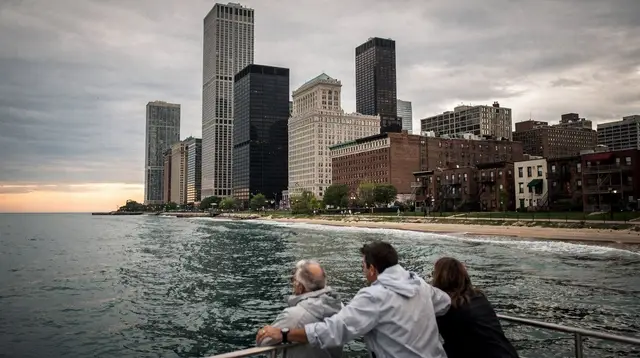
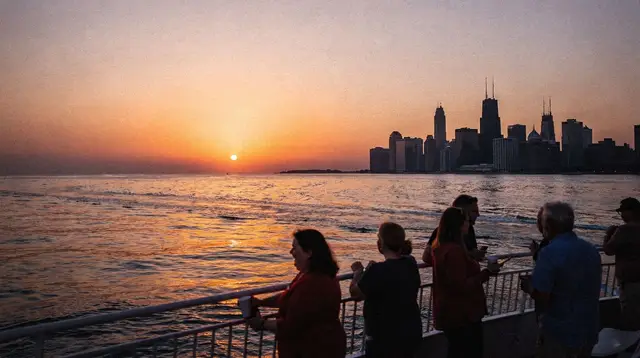
The classic Loop skyscrapers walking tour
What does a classic Loop skyscrapers walking tour actually cover?
It's a self-paced or guided walk through downtown Chicago's central business district, tracing how the city rebuilt after the 1871 fire and became the birthplace of the modern skyscraper. Expect 2 to 4 km on foot past buildings spanning the 19th century Chicago School through today's towers, with no ticketed entries required for the walk itself.
Chicago didn’t invent the tall building by accident. It rebuilt itself after a disaster, and the skyscraper was the result. Walking the Loop with that story in mind turns a few blocks of downtown sidewalk into a readable timeline: 19th century steel-frame experiments, early 20th century ornament, mid-century glass towers, and the contemporary infill that keeps going up between them.
This guide covers the classic, generalist version of that walk: the one that tries to show the whole arc rather than a single style. If you want the Art Deco period specifically, with its stepped setbacks and stylized ornament, that’s its own page — see the Art Deco skyscrapers walking tour instead. If this is your first visit to the city at all, the first-time visitor guide to Chicago is a useful starting point before narrowing in on architecture specifically. This one is for a first visit to the Loop where you want the throughline, not a deep dive into one decade.
Why the Loop looks the way it does
The Great Chicago Fire of October 1871 destroyed a large part of the city’s core, including most of what’s now downtown. That destruction is the reason the Loop looks the way it does today: almost nothing standing predates the fire, and the reconstruction that followed became a proving ground for new building technology. Architects and engineers working in Chicago in the following decades — Louis Sullivan and Daniel Burnham among the most cited — pushed steel-frame construction and taller, more efficient office buildings further than almost anywhere else in the world at the time. That body of work is often grouped under the label “Chicago School.”
Later waves added their own layers. Ludwig Mies van der Rohe’s influence after he moved to Chicago pushed the city toward the minimal glass-and-steel towers that define a lot of the mid-century skyline. More recent decades have filled remaining lots with contemporary towers that borrow from, react against, or ignore all of the above. Walk two blocks in the Loop and you can often see three different eras of that argument standing next to each other.
This guide deliberately avoids pinning exact construction dates to individual buildings, since sourcing a reliable year for each one is beyond what a general walking guide can verify block by block. Think of the route in terms of eras and styles rather than a precise timeline, and treat any date claims elsewhere with a healthy dose of skepticism unless they cite the building’s owner or a recognized architecture body.
What the walk actually covers
The Loop is the historic core of downtown Chicago, defined loosely by the loop of elevated CTA track that gives the neighborhood its name. A classic skyscraper walk moves through this compact grid on foot, at street level, stopping to look at building exteriors and, where accessible, public lobbies. It does not require tickets, reservations, or timed entry — the walk itself is free, though individual attractions along or near the route are not.
A typical route strings together a mix of the following, depending on which guide or route map you follow:
- Early Chicago School office buildings in the eastern and central Loop, some of the clearest surviving examples of the steel-frame innovations that made tall buildings structurally possible.
- Civic and cultural buildings along Michigan Avenue and around Millennium Park, where you’ll also pass the free-to-enter Cloud Gate sculpture — a natural stop, though it’s a separate attraction from the walk itself.
- Mid-century towers reflecting the glass-and-steel minimalism associated with Mies van der Rohe’s Chicago period.
- The Willis Tower on the western edge of the Loop, at 233 South Wacker Drive — worth knowing by its current name, since older references and plenty of visitor searches still use its former name, Sears Tower, which it carried until 2009.
- A handful of contemporary infill towers that show how the conversation about height, material and ornament kept evolving after the mid-century period ended.
If your interest is specifically in the Art Deco vocabulary — stepped setbacks, geometric ornament, a particular stretch of buildings from one stylistic period — the dedicated Art Deco skyscrapers walking tour guide narrows the same neighborhood down to that one thread. This page stays broader on purpose.
Guided versus self-guided
You can walk this route with no ticket and no guide: it’s public sidewalks, and most of what you’re looking at is visible from the street. A printed or phone map with building names marked is enough to follow the general arc described above.
A guided walking tour adds context that’s hard to get standing on a sidewalk with a phone: which structural innovations mattered and why, what changed after the fire, how the Chicago School’s ideas spread beyond the city, and which small details are worth noticing on a facade you’d otherwise walk past. Several guided options run this general-interest route rather than a single-style deep dive:
The 90-minute walk tracing the evolution of the skyscraper through the Loop is the closest match to the angle of this guide — it’s built around the same broad, multi-era story rather than one architectural period. For a longer format that folds in more general Loop history alongside the buildings, a guided walk through Chicago’s historic skyscrapers covers similar ground at a more relaxed pace. If you’d rather combine architecture with a wider cultural read of downtown, a Loop walking tour blending architecture, history and culture is built for that. And if standing still and looking up for two hours isn’t your preferred pace, the elevated architecture walking tour covers a comparable route with a different rhythm.
None of these require you to also book a river cruise or an observation deck — they’re street-level walks that stand on their own, though pairing one with a cruise or a deck visit on the same day is common and covered separately below. If you’d rather see the same buildings from the water, the architecture river cruise guide covers that alternative, and the architecture cruise versus walking tour comparison breaks down which format suits which visitor.
Distance, pacing and physical difficulty
The Loop is flat, compact, and built on an ordinary street grid, so this isn’t a demanding walk in the way a hike would be. Most versions of the route cover somewhere between 2 and 4 km depending on how far the itinerary strays toward Michigan Avenue or Wacker Drive, and how many stops it includes. At an easy pace with stops to read plaques and look up at facades, budget 2 to 3 hours for a self-guided walk, or roughly 90 minutes to 2 hours for a guided one moving on a schedule.
There are no stairs built into the route itself — everything is street-level sidewalk. The two factors that actually affect difficulty are weather (see below) and downtown foot traffic, which spikes hard around the lunch hour on weekdays. Comfortable shoes matter more than fitness level here.
Best time of day, by season
Because this is an outdoor, street-level walk with no fixed opening hours to plan around, timing comes down to light, temperature and crowding rather than a ticket window.
| Season | Best time of day | Why |
|---|---|---|
| Winter (Dec–Feb) | Late morning to early afternoon | Milder temperatures and more daylight; Chicago winter days run cold and windy, often around 0°C, so avoid early morning and dusk |
| Spring | Mid-morning | Cooler mornings and afternoons are pleasant once the season turns; weather is changeable, so check the forecast the day before |
| Summer (Jun–Aug) | Early morning or early evening | Midday heat and humidity build fast, with daytime temperatures often in the 25–28°C range; the added glare off glass towers makes midday walking less comfortable, not more scenic |
| Fall | Late morning through mid-afternoon | Widely considered the most comfortable season for walking downtown, with milder temperatures and thinner crowds than summer |
Whatever the season, avoid the weekday noon hour if you can — that’s when Loop office workers flood the sidewalks on lunch breaks, which makes photography and unhurried walking harder, not impossible. For a broader look at how the seasons compare across the whole city, not just this walk, see the guide to the best time to visit Chicago. If you’re visiting in the colder months, the Chicago winter activities guide rounds up indoor options to pair with a shorter outdoor walk, and summer visitors can pair the route with the Chicago summer lakefront guide for the lake side of a downtown day.
What this walk doesn’t include
A few common points of confusion worth clearing up before you go:
- This is not a river cruise. Chicago’s architecture river cruises view many of the same buildings from the water, along the Chicago River, departing near the Riverwalk. It’s a genuinely different experience — see the Chicago Riverwalk guide if you want to add one to your day.
- This is not an observation deck visit. The Willis Tower’s Skydeck, with its glass Ledge balconies, sits inside the tower itself at 233 South Wacker Drive; the separate 360 Chicago observation deck with the TILT attraction is over 2 km away at 875 North Michigan Avenue, in a different building under a different operator. Both are worth adding to a Loop day, but neither is part of a street-level skyscraper walk, and the two are frequently and wrongly assumed to be the same building — the Skydeck comparison guide lays out the difference in more detail.
- This isn’t a full Loop neighborhood tour. If you want the wider story of the Loop beyond its buildings — its shops, its transit hub, its daily rhythms — the Chicago Loop walking tour guide page covers that broader ground; this page stays focused on architecture specifically.
- This isn’t a Segway tour. If walking isn’t your preferred way to cover this ground, the Segway tour of Chicago covers a wheeled alternative through a similar stretch of downtown.
Pairing the walk with the rest of the Loop
Because the route runs entirely through the Loop and its immediate edges, it pairs naturally with other things already in the neighborhood. Millennium Park and the free Cloud Gate sculpture sit right along most versions of the route. The Art Institute of Chicago, a paid museum, is close enough to add on either before or after. The Willis Tower anchors the western end of most routes, and its Skydeck is a natural add-on if you want the view to match the ground-level history — book it separately, since it isn’t bundled into any of the walking tours above.
If you’re building out a longer day or want the wider set of options for seeing this same architecture from different angles — cruises, other walking routes, or comparisons between them — the best architecture tours in Chicago guide rounds those up in one place. For those with less time, the one-day Loop, no car itinerary slots this walk into a full day downtown, and the three-day Chicago itinerary for first-timers works it into a longer trip alongside the Museum Campus and the lakefront.
What it costs
The walk itself, self-guided, is free — public streets, no admission. A guided version typically runs somewhere in the range most Chicago walking tours charge, and prices shift by season and provider, so check the current rate on the operator’s own booking page rather than relying on a fixed number here. Keep in mind that displayed prices in Chicago are before sales tax, which runs around 10% on most purchases in the city — a detail more relevant to meals and shopping along the way than to the tour itself, but worth knowing before you tally up a day downtown.
If you’re stacking several paid attractions around the walk — the Skydeck, the Art Institute, the Museum Campus — it’s worth checking whether a multi-attraction pass pencils out; the Chicago CityPASS and Explorer Pass guide compares the two. And if budget is the main constraint, the walk itself fits neatly into the free and cheap things to do in Chicago list.
Practical notes before you go
- Dress for the season, not the forecast alone. Chicago’s nickname, the Windy City, isn’t just folklore — wind funneled between tall buildings can make a mild day feel colder, especially near Wacker Drive and the river.
- Bring water in summer. There’s no shortage of places to buy a drink in the Loop, but humidity builds faster than most visitors expect.
- Check the walk isn’t the only thing on your list for the day. The Loop is dense enough that architecture, a museum stop, and a coffee break all fit into a half-day without rushing.
- Skip trying to time individual building visits by opening hours. This guide deliberately leaves out specific hours for any site along the route, since a walking tour is about exteriors and public spaces, not interiors that require scheduling.
- Getting to the Loop is straightforward on transit. Both CTA train lines and Metra commuter rail converge on the neighborhood; the CTA “L” train guide explains how the system works, and the broader getting around Chicago without a car guide covers the rest of downtown if you’re planning a car-free trip.
- Traveling with luggage before or after the walk? The Chicago luggage storage guide covers short-term options near the Loop so you’re not carrying bags between building stops.
- Chasing photos of the skyline itself, not just street-level shots? The best sunset views of the Chicago skyline guide and the professional photoshoot in Chicago guide cover options beyond what you’ll capture on this walk.
Frequently asked questions about the Loop skyscrapers walk
Common questions from visitors weighing a guided walk against doing it themselves, or trying to figure out where this route fits alongside Chicago’s other architecture activities.
How long does the walk take?
Most people cover the core Loop skyscraper route in 2 to 3 hours at an easy pace, including stops to look up and read plaques. A guided version usually runs 90 minutes to 2 hours since it moves on a schedule.
Do I need to buy tickets to see the buildings?
No. This is a street-level walk past building exteriors and lobbies you can enter freely. It’s separate from paid attractions like the Skydeck inside the Willis Tower, which you can add on but which isn’t part of the walking route itself.
Is the walk physically demanding?
No. The Loop is flat and compact, and the route follows ordinary sidewalks with no stairs required. It suits most fitness levels, including families with older kids, though summer humidity and winter wind are the real limiting factors, not the distance.
What’s the difference between this tour and the Art Deco walking tour?
This route is generalist: it follows the whole arc of Chicago architecture, from post-fire reconstruction and the Chicago School through Art Deco and into contemporary towers. The Art Deco walking tour narrows in on one stylistic period and its buildings specifically.
When is the best time of day to do this walk?
Weekday mid-morning to early afternoon gives the best light between the towers and the fewest crowds on the sidewalks, though it also means dodging office lunch traffic around noon. See the seasonal timing table above for specifics.
Can I do this walk on my own without a guide?
Yes. The route follows public streets and requires no tickets, so a self-guided walk with a map works fine. A guide adds the history and the details you’d otherwise miss, which is the main reason to book one over walking it cold.
Does the walk include the Chicago Riverwalk or a boat cruise?
No, this is a street-level, on-foot itinerary. The river and its architecture cruises are a different way to see many of the same buildings from the water, and worth doing as a separate activity, not a substitute — see the The Chicago Riverwalk: a guide to the walk itself page for that.
Chicago River architecture and sightseeing cruises on GetYourGuide
Verified deep-linked GetYourGuide tours. Book through these links and we earn a small commission at no cost to you.
GetYourGuide does not provide a product photo for this activity — the image shows the meeting point, photographed by us.