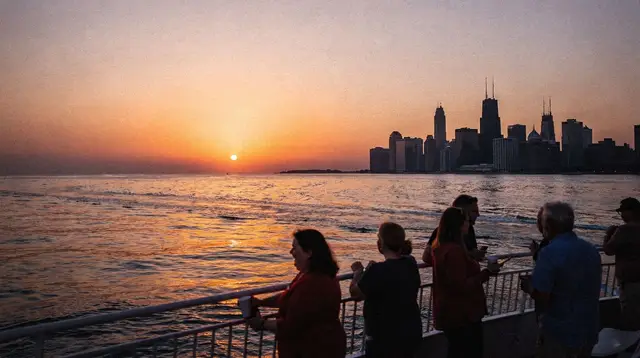
Three days in Chicago: the first-timer itinerary
This plan is built for someone landing in Chicago for the first time with three days, no car, and a wish to actually see the landmarks everyone mentions rather than just walk past them. It stays inside downtown and the near North Side on purpose: the Loop, the Riverwalk, the Magnificent Mile, the Museum Campus, Navy Pier, and Lincoln Park. It does not attempt Hyde Park, the South Side, Oak Park, or any day trip — those need their own time and are covered in other guides. Prices below are in USD and shown as ranges, before the roughly 10% Chicago sales tax; always confirm the current figure on the official site linked for each stop.
Before you go: getting downtown
If you’re flying into O’Hare, the CTA Blue Line runs directly to the Loop in about 40 to 45 minutes. From Midway, the Orange Line takes roughly 25 to 30 minutes. Both lines use the Ventra card system — buy one at the airport station before you need it, since fumbling with fare machines is a bad way to start a trip. For getting around during the three days, see the CTA L train guide and the broader guide to getting around Chicago without a car. Only the Red Line and Blue Line run 24 hours; the lines used in this itinerary (mostly buses and short Loop walks) run daytime and evening hours without issue.
Day 1: The Loop, the Skydeck, and the river
9:00am–1:00pm: The Loop, Millennium Park, and the Art Institute
Start in the Loop, Chicago’s historic downtown core, named for the elevated CTA tracks that ring it. Walk to Millennium Park first — entry is free, and Cloud Gate (“the Bean”), Anish Kapoor’s reflective sculpture, needs no ticket and no advance booking. Arrive before 10am if you want photos without a wall of people; by midday it’s genuinely crowded.
From the park, it’s a short walk to the Art Institute of Chicago, which is not free — expect roughly 30 USD for an adult ticket, and check artic.edu for the current price and any local free-admission days before you go. Budget two hours if you want to see the Impressionist galleries and the American wing without rushing. If museums aren’t your priority, skip it and instead walk the Loop’s skyscraper streets — Sullivan and Burnham’s buildings are half the reason this itinerary exists.
1:00pm–3:00pm: Lunch and the Willis Tower Skydeck
Grab lunch somewhere in the Loop — the area is full of quick counter-service options aimed at office workers, which means decent food without a long wait. Then head to the Willis Tower at 233 South Wacker Drive for the Skydeck, entered from Jackson Street on the tower’s south side. The Skydeck is open roughly 9am to 8pm most days (later on Saturdays), and a standard adult ticket runs about 30 to 35 USD, more with skip-the-line access — confirm on theskydeck.com since pricing shifts by season.
The Ledge, the glass balconies that jut out from the 103rd floor, is included in Skydeck admission and is the single most photographed moment on this itinerary. Note this clearly: the Skydeck is inside the Willis Tower in the Loop, not on Michigan Avenue — that’s the 360 Chicago observation deck, which comes later on day two. Confusing the two is the most common mistake visitors make with Chicago’s observation decks; the full comparison is in the Skydeck vs. 360 Chicago guide.
Booking a Skydeck ticket ahead of time avoids a line that can run 30 to 60 minutes on a busy afternoon. A mobile ticket option also exists through a digital Willis Tower Skydeck pass if you’d rather skip printing anything.
3:00pm–6:00pm: The Riverwalk, an architecture cruise, and Michigan Avenue
Walk north from the Loop to the Chicago Riverwalk, the path along the river’s south bank that has become one of downtown’s better free attractions in its own right — cafes, kayak rental docks, and river-level views of the same skyscrapers you just saw from above. This is also where most architecture river cruises depart.
Book a 1 hour 15 minute architecture river cruise from the Loop docks for late afternoon; the guides (often volunteers trained by the Chicago Architecture Center) explain how the 1871 fire forced Chicago to rebuild in steel and glass, effectively inventing the modern skyscraper. It’s consistently one of the highest-rated activities in the city, and doing it after the Skydeck gives you both the aerial and the street-level version of the same skyline in one afternoon. The full range of operators and boat types is covered in the architecture river cruise guide; a second option is the Architecture River Tour if you want a shorter or differently timed departure.
After the cruise, walk the Riverwalk east and cross north onto Michigan Avenue and the Magnificent Mile — window-shop, or just enjoy the walk before dinner.
Evening: dinner in River North
River North, just north and west of Michigan Avenue, has Chicago’s densest concentration of steakhouses, cocktail bars, and casual spots, and it’s an easy walk or short bus ride from where day one ends. No booking needed here — just pick a direction and eat.
Day 2: Museum Campus, Navy Pier, and 360 Chicago
9:00am–1:00pm: One museum on the Museum Campus
Take a bus from the Loop down to the Museum Campus, the lakefront cluster holding the Field Museum, the Shedd Aquarium, and the Adler Planetarium. These are three separate, independently ticketed institutions — not one combined museum — so pick exactly one for this morning rather than trying to rush all three. The Field Museum suits dinosaur and natural-history fans, the Shedd suits families and aquarium lovers, and the Adler suits anyone who wants a planetarium show. Each charges its own adult admission, generally in the 25 to 40 USD range depending on which exhibits or shows you add; check fieldmuseum.org, sheddaquarium.org, or adlerplanetarium.org directly, since none of these prices are fixed year to year. The Museum Campus tours guide breaks down which museum fits which traveler in more detail.
Trying to do two museums here in one morning is the classic first-timer overreach — you’ll end up rushing both and enjoying neither. Pick one, see it properly, and save the others for a future trip or a longer stay.
1:30pm–5:00pm: Navy Pier
From the Museum Campus, head north along the lakefront toward Navy Pier, either on foot along the Lakefront Trail (roughly 45 minutes to an hour at a relaxed pace) or by bus if your legs are tired from the museum. Navy Pier itself is free to enter — there’s no gate fee for walking onto the pier — but its attractions charge separately. The Centennial Wheel, the pier’s Ferris wheel, is the signature ride; a Centennial Wheel ticket gets you a lake-view rotation without waiting in the walk-up line, which on summer weekends can run long.
Navy Pier also has restaurants, a beer garden, and lake views that are worth the walk even if you skip every paid attraction. Hours are seasonal — check navypier.org before you go, since winter hours run shorter than summer ones.
5:00pm–8:00pm: 360 Chicago and TILT, for the evening view
End the day at 360 Chicago, the observation deck on the 94th floor of 875 North Michigan Avenue — the tower formerly known as the John Hancock Center until 2018. This is a different building and a different company from yesterday’s Skydeck, roughly 2 kilometers south on Wacker Drive; the two get confused constantly, and this itinerary deliberately visits both so you can compare them yourself.
360 Chicago is typically open 9am to 11pm, with last entry an hour before close, making it well suited to a sunset-into-dark visit — adult admission runs around 30 USD, confirmed on 360chicago.com. TILT, the platform that tilts visitors out over Michigan Avenue, is a separate add-on ticket, roughly 8 to 10 USD more. The full rundown, including how the view compares to the Skydeck’s, is in the 360 Chicago and TILT guide.
Day 3: Lincoln Park, Old Town, and free time
10:00am–1:00pm: Lincoln Park and Old Town
Take the Red Line north and walk into Lincoln Park and Old Town, the neighborhood pairing that anchors the North Side. Lincoln Park Zoo is free — no ticket, no timed entry — and small enough to see thoroughly in an hour or so. Afterward, walk the park’s lakefront paths along Lake Michigan; remember this is a freshwater lake, not an ocean, and that the municipal beaches only run lifeguarded from late May to early September, so a September or October visit means views, not swimming.
Old Town, just south of the park, is where Chicago’s comedy scene traces its roots (Second City is here), and its residential streets of restored 19th-century row houses are worth a slow walk before lunch.
1:00pm–3:00pm: Lunch in Old Town
Old Town has a manageable, walkable restaurant strip — nothing here requires advance planning, just pick somewhere and sit down before the afternoon.
3:00pm–6:00pm: Free time — Michigan Avenue or a neighborhood
Close the trip with unstructured time. Head back down to Michigan Avenue for shopping if that’s your interest, or go the other direction into Wicker Park or the West Loop for a neighborhood feel that’s different from downtown — Wicker Park leans toward independent boutiques and street art, while the West Loop and Fulton Market lean toward restaurants and a newer, more industrial-turned-trendy streetscape. Either choice works as a low-key close to a three-day trip built mostly around scheduled stops.
Where this itinerary stops — and what comes next
This three-day plan is deliberately downtown-and-lakefront only. It skips Hyde Park and the South Side (the University of Chicago, the Museum of Science and Industry), it skips Oak Park and Frank Lloyd Wright’s studio, and it skips every day trip — Milwaukee, Starved Rock, Galena. None of those are lesser stops; they simply don’t fit inside three days without cutting the Loop-and-lakefront core down to something rushed. If you have a fourth or fifth day, the one-week Chicago itinerary with day trips picks up exactly where this one leaves off, and the Oak Park and Frank Lloyd Wright day trip is the natural next add.
For a faster or slower version of just day one, see the one-day Loop itinerary without a car or the one-day architecture and river cruise itinerary, both of which cover the same ground in more or less depth.
Frequently asked questions about this three-day Chicago itinerary
Is three days enough to see Chicago?
Three days covers the core downtown experience well: the Loop, the riverfront, one observation deck, the Museum Campus, Navy Pier, and Lincoln Park. It does not leave room for Hyde Park, Oak Park, or day trips like Milwaukee or Starved Rock — plan a return trip or add days for those.
Do I need a car for this itinerary?
No. Everything in this three-day plan sits within downtown Chicago and the near North Side, reachable on foot, by CTA bus, or by the L. A car adds parking cost and hassle without saving time here.
Should I book the Skydeck and 360 Chicago on the same trip?
This itinerary does exactly that on purpose, one on day one and the other on day two evening, so you get a daytime view from the Willis Tower and a sunset-into-night view from 875 North Michigan Avenue. They are different buildings and different companies; skipping one to save money is reasonable if budget is tight.
Which Museum Campus museum should I pick for day two?
The Field Museum suits visitors who like natural history and dinosaurs, the Shedd Aquarium suits families and marine life fans, and the Adler Planetarium suits anyone drawn to space and shows. This itinerary budgets time for one museum only; seeing two properly in a single morning is not realistic.
How much walking does this itinerary involve?
A fair amount. Day one alone covers the Loop, the Riverwalk, and Michigan Avenue on foot, plus a seated boat cruise. Day two mixes bus riding with walking along the lakefront to Navy Pier. Comfortable shoes matter more than a car.
What if it’s raining or freezing on one of these days?
Millennium Park, the Riverwalk, and the Lincoln Park lakefront are all outdoor and weather-dependent; swap that day for the Art Institute, the Museum Campus museum, or 360 Chicago, all indoors, and push the outdoor day to better weather if your trip allows it.
What time of year is best for this itinerary?
Spring and fall bring milder temperatures and thinner crowds, while summer (June to August, days typically 25 to 28°C) makes the lakefront and beaches usable but adds heat and humidity. Winter (December to February, days often around 0°C and windy) still works for the indoor stops but turns the Riverwalk and Lincoln Park legs into a colder, shorter walk.
Tours for your first trip to Chicago on GetYourGuide
Verified deep-linked GetYourGuide tours. Book through these links and we earn a small commission at no cost to you.
GetYourGuide does not provide a product photo for this activity — the image shows the meeting point, photographed by us.