Why the Loop is where most visits start
Chicago’s skyscraper story begins here, inside the ring the elevated train tracks trace around downtown. The Loop takes its name from that literal loop of CTA track, and everything inside and just beside it — Millennium Park, the Art Institute of Chicago, the canyon of early skyscrapers along LaSalle and Dearborn, and the shopping strip along State Street — sits within a few blocks of any given station. It is dense, walkable, and built for a weekday. On a Saturday evening it can feel oddly hollow, because the Loop is still, at its core, a business district: banks, law firms, and government offices, not nightlife.
That makes it a strong fit for a specific kind of visitor: people who want art and architecture packed into a short trip, people arriving with limited days who want to cover the highlights on foot, and anyone staying downtown who would rather not deal with rideshares or driving. It is a weaker fit for anyone chasing evening energy or lakefront time — the Riverwalk runs along the river at the Loop’s north and west edge, and the Museum Campus and Navy Pier sit further east and south on the lake itself, each with its own character and its own guide.
Getting here from the airports
Both of Chicago’s airports connect straight into the Loop on the CTA “L,” with no transfer required. From O’Hare (ORD), the Blue Line runs downtown in about 40 to 45 minutes. From Midway (MDW), the closer of the two airports, the Orange Line takes about 25 to 30 minutes. Both lines terminate at or near Loop stations, and a Ventra card (physical or via app) covers the fare on either train. For a fuller walkthrough of fares, transfers, and what to do with luggage on the train, see the guide to getting from O’Hare to downtown and the general CTA “L” guide.
Once you are in the Loop, you rarely need transit again inside it. The whole district is roughly a mile across, flat, and gridded, and every CTA line converges on it, which makes it the single easiest part of Chicago to reach without a car — see the guide to getting around Chicago without a car for the citywide picture.
Millennium Park and the Bean
Millennium Park sits at the Loop’s northeast corner, bordered by Michigan Avenue, and it is free to enter with no ticket of any kind. Its best-known feature is Cloud Gate, the reflective, bean-shaped sculpture by Anish Kapoor that everyone calls “the Bean.” It is free, always open to the public, and busiest at midday; early morning or late afternoon light gives cleaner photos and a thinner crowd. The park also holds the Jay Pritzker Pavilion, an outdoor concert venue with a free summer music series, and the Crown Fountain, a pair of glass-block towers that project faces and spout water, popular with kids in warm months.
Because the park is free and outdoors, it works in any weather and any season, though a Chicago winter (cold, often windy, hovering around freezing during the day) makes it a shorter stop than a mild fall afternoon. It anchors most people’s first hour or two in the Loop before they move on to the museum next door.
The Art Institute of Chicago
Immediately south of Millennium Park, facing the park across Monroe Street, is the Art Institute of Chicago — one of the largest and best-regarded art museums in the country, and, unlike the park beside it, a paid ticket. Adult admission runs in the rough range of USD 30, though the exact price, member and student discounts, and any locally offered free days change over time; check artic.edu directly before you go rather than relying on a fixed figure here.
Inside, the collection spans Impressionist and Post-Impressionist painting (including several Monets and Seurat’s “A Sunday on La Grande Jatte”), American art (Grant Wood’s “American Gothic”), and a strong contemporary and photography program. Budget at least two to three hours for a first visit; art-focused travelers can easily spend most of a day. For a plan on how to move through the collection efficiently, see the Art Institute fast-pass guide.
The skyscraper canyon
Walk a few blocks west or south from the museum and the Loop turns into the reason architects study Chicago in the first place. This is where the skyscraper was effectively invented after the Great Fire of 1871 forced a full rebuild of the city, and where the Chicago school of architecture — Louis Sullivan, Daniel Burnham, and later Ludwig Mies van der Rohe — left its clearest mark. LaSalle Street, Dearborn Street, and the blocks around them hold early steel-frame towers, ornate terra-cotta facades, and Mies’s own severe glass-and-steel work at the Federal Center, all within easy walking distance of each other.
The Willis Tower (formerly the Sears Tower until 2009) stands at 233 South Wacker Drive, on the Loop’s western edge, and its Skydeck observation floor — with the glass-floored Ledge balconies — is one of the city’s signature views. It gets its own dedicated page rather than a deep treatment here: see the Skydeck guide for hours, ticket ranges, and how it differs from the unrelated 360 Chicago observation deck at 875 North Michigan Avenue, over two kilometers away on the Magnificent Mile. Confusing the two is the single most common mix-up visitors make about Chicago’s skyline views, since they are run by different companies and sold as separate tickets.
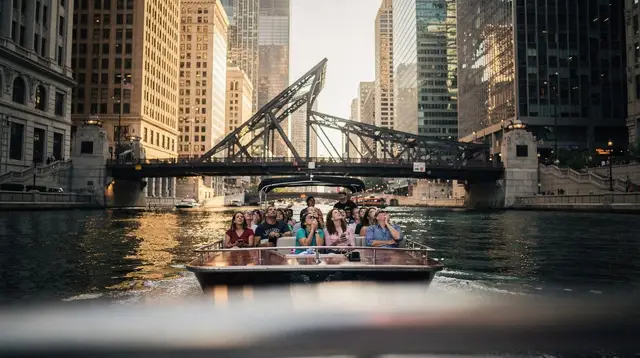
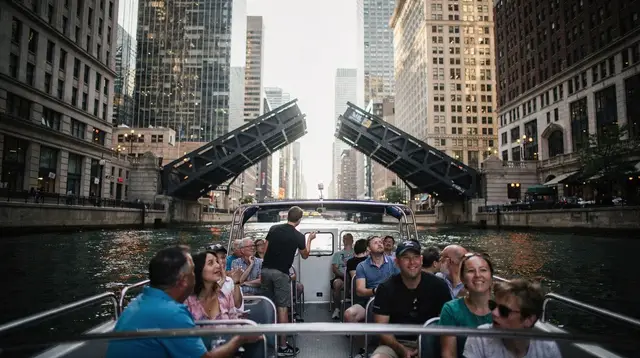
For a structured way to see the architecture rather than wandering block by block, a guided walking tour or a river architecture cruise (departing from the Riverwalk just north of the Loop) covers the highlights with context a self-guided walk misses. The 90-minute walking tour tracing the evolution of the skyscraper runs directly through this stretch of the Loop and is a practical way to fit the architecture into a single morning. For the river-based alternative, see the architecture river cruise guide and the general best architecture tours in Chicago roundup, which compares boat and walking options side by side.
State Street, Michigan Avenue, and where the Loop ends
State Street, once billed as “that great street,” runs north-south through the Loop’s retail core, with Macy’s occupying the historic Marshall Field’s building as its anchor. It is a workaday shopping street rather than a glamorous one; for higher-end retail, most visitors cross east to Michigan Avenue and continue north onto the Magnificent Mile, which starts at the river and is covered on its own page — see the Magnificent Mile walking tour guide.
The Loop’s boundaries are worth being precise about, because several nearby areas that get lumped in with “downtown” actually have their own identity and their own pages on this site. The Riverwalk runs along the south bank of the Chicago River at the Loop’s northern edge and is where most architecture cruises depart; it is detailed on its own Riverwalk guide and Riverwalk-specific guide. East and south of the Loop, past Grant Park, the Museum Campus (Field Museum, Shedd Aquarium, Adler Planetarium — three separate, paid tickets) and Navy Pier (free to enter, with paid attractions inside) sit directly on the lake; see the Museum Campus tours guide for that stretch. None of these are covered in depth here, only noted for how close they sit to the Loop’s edge.
The Chicago Cultural Center and free views
One stop in the Loop gets overlooked simply because it costs nothing: the Chicago Cultural Center, a block east of Millennium Park at Michigan Avenue and Washington Street. Built as the city’s original public library in 1897, it holds what is often called the world’s largest stained-glass Tiffany dome, along with rotating art exhibits and free classical and jazz concerts most weeks. It rarely appears on a first-timer’s list precisely because there is no ticket to buy, but it is one of the more striking interiors downtown and takes only 20 to 30 minutes to see properly, making it an easy add-on between Millennium Park and the Art Institute.
A few blocks south, the Federal Center plaza (Mies van der Rohe’s austere black-steel towers and Alexander Calder’s red “Flamingo” sculpture) offers a free, five-minute contrast to the Cultural Center’s ornate dome: two very different eras of Chicago architecture within a ten-minute walk of each other. Neither requires advance planning or a ticket, which makes both good filler stops on a day that is otherwise built around timed entries at the Art Institute or a booked walking tour.
Getting oriented on the “L” once you are downtown
The Loop is unusual among Chicago neighborhoods in that its name comes directly from the transit that surrounds it: all eight CTA “L” lines pass through or terminate at Loop stations, elevated on the steel structure that rings the district. That makes the Loop the one place in the city where you can reach almost anywhere else without backtracking through downtown first. Only the Red Line and the Blue Line run 24 hours; the other lines that serve the Loop stop overnight, so a late dinner in River North or a show in the West Loop generally means a rideshare or a cab back rather than a train after the last scheduled run. For the fare details, transfer rules, and a line-by-line rundown, see the CTA “L” guide.
Divvy bike-share docks are scattered throughout the Loop as well, and on a mild day a short ride along the Riverwalk or down to Grant Park can cover ground faster than walking, though the Loop’s dense one-way grid and heavy taxi and bus traffic make it a less relaxed ride than the dedicated Lakefront Trail further east.
A rainy-day or winter Loop
Chicago’s winters are a real planning constraint here, not just a line in a packing list: daytime highs often sit near freezing, and the wind funneling between the tall buildings can make the walk between Millennium Park and the Art Institute feel longer than its few hundred meters. On a cold or wet day, the Cultural Center, the Art Institute, and the enclosed pedways connecting several Loop office buildings let you cover a surprising amount of the district without stepping outside for long. Summer runs the opposite risk: warm, humid afternoons in the 25-28°C range make the shadeless plazas around Federal Center and the Willis Tower feel hotter than the temperature suggests, so late morning or early evening visits beat midday in July and August. See the Chicago winter activities guide and the best time to visit Chicago page for how the Loop fits into the wider seasonal picture.
A practical day plan
| Time | Activity | Cost (before tax) |
|---|---|---|
| Morning | Millennium Park and Cloud Gate | Free |
| Late morning | Art Institute of Chicago | ~USD 30 |
| Early afternoon | Lunch on or near State Street | USD 15-25 |
| Afternoon | Skyscraper walking tour or self-guided Loop walk | USD 25-45 for a guided tour |
| Late afternoon | Riverwalk stroll (just north of the Loop) | Free |
| Evening | Dinner outside the Loop (River North or West Loop) | USD 25-50 |
Treat this as a template rather than a fixed script; swap the museum and the walking tour if art matters less to you than architecture, or add the Skydeck if you have a second day. For a fuller multi-day frame that places the Loop alongside the rest of downtown, see the one-day Loop, no-car itinerary or the two-day highlights itinerary.
What the Loop is not good for
Two honest caveats. First, nightlife: the Loop is a 9-to-5 district, and after office towers empty out, so do most of its sidewalks. Restaurants close earlier here than in neighborhoods built around evening trade, and weekends can feel unusually quiet for a downtown. If an evening out matters to your trip, base it in River North, the West Loop and Fulton Market (Chicago’s fastest-growing restaurant district, just west of the Loop), or Wicker Park instead.
Second, the lake: the Loop itself does not front Lake Michigan directly. Grant Park and the Museum Campus separate it from the shoreline, and the closest beaches and the Lakefront Trail lie beyond that. If lakefront time is a priority, plan it as a separate stretch of your day rather than expecting it inside the Loop walk.
With a family in tow, indoor options inside easy reach of downtown include the Legoland Discovery Center in the Chicago area, a useful fallback on a rainy or brutally cold day when an outdoor architecture walk is less appealing. And for an evening that leans into the city’s darker history once the office crowds have thinned, the Windy City ghost tour through downtown’s older, stranger corners is a way to use those quiet after-hours streets rather than fight them.
Practical notes before you go
Prices quoted throughout this guide, and on the tickets you will buy in the Loop, are before Chicago’s roughly 10.25% sales tax as of 2026 — the rate has shifted before and may again, so treat it as a working figure rather than a fixed one. If you are staying downtown, hotel bills in and around the Loop carry Chicago’s hotel accommodation tax on top of that, one of the steepest in the country at roughly 17 to 19% depending on the property, revised upward again in 2026; check chicago.gov for the current rate rather than trusting any single number as final. Restaurant tipping follows the usual American range, around 18 to 22%.
Chicago runs on Central time, CST in winter and CDT in summer (the clocks change on the usual U.S. schedule, second Sunday of March to first Sunday of November), which trips up visitors used to destinations that skip daylight saving. And weather matters more here than in many downtowns: winters are genuinely cold and windy, with daytime highs often near freezing, while summer days run warm and humid, typically in the 25-28°C range — spring arrives late, and fall is widely considered the most comfortable season to walk the Loop’s open plazas and skyscraper canyons.
For a wider frame on when to come at all, see best time to visit Chicago, and for ticket bundling across the Art Institute, Skydeck, and the Museum Campus, see the CityPASS and Explorer Pass guide.