Where the river meets the Loop
The Chicago Riverwalk is a paved public path that runs along the south bank of the main branch of the Chicago River, threading beneath the skyscrapers of the Loop on one side and facing the towers of Streeterville and the Magnificent Mile on the other. It is not a park you drive to and park at; it is a strip of downtown, usually just one or two levels below street grade, that turns a working river into the easiest outdoor walk in the city. Most first-time visitors reach it without planning to, stumbling down a staircase from Wacker Drive and finding themselves at water level with the Willis Tower rising behind them.
This page covers what actually happens on the Riverwalk itself: the boat cruises and water taxis that launch from its docks, the riverside bars and restaurants built into its arches, the lift bridges that still occasionally open for sailboats, and the views of the towers that line the water. It does not cover the architecture of the Loop in general (that has its own guide), the lake and its beaches, or the observation decks at the top of the Willis Tower or 875 North Michigan Avenue — those are separate destinations with their own pages, and treating them here would just repeat the same ground.
Orientation: which stretch you are actually on
The Riverwalk is built in a series of connected blocks, not one continuous ribbon, and the character changes block by block. Near Lake Shore Drive at the eastern end, it opens onto the lake and feels more like a plaza. Moving west through the Loop, it narrows and passes under the lower decks of Wacker Drive, with restaurant patios tucked into the arches of the bridges. By the time it reaches the western Loop near Lake Street, the crowds thin out and the feel turns quieter and more industrial. None of this is signposted clearly, so if a friend describes the Riverwalk as “packed with bars” or “kind of empty,” you are both right, just talking about different blocks.
Getting oriented is simple because the river runs east-west through downtown and nearly every Loop L station sits within a few blocks of it. The Blue, Red, Brown, Orange, Green, Pink and Purple Lines all converge on the Loop, so whichever train you take, you are close. Commuters and day-trippers coming in on the Metra land even closer: Ogilvie Transportation Center and Union Station both sit a short walk from the river’s western stretch. There is no reason to drive here, and parking downtown is expensive enough that getting around without a car is genuinely the easier option.
Boat cruises: the main event on the water
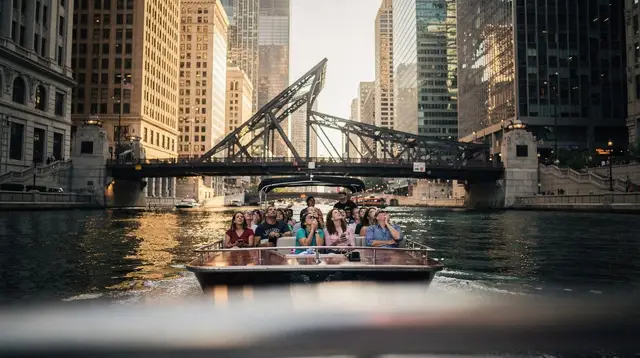
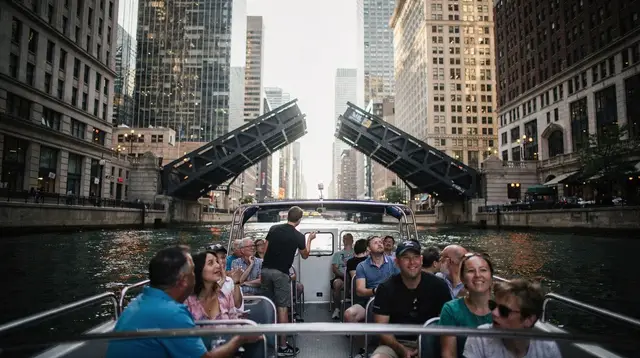
The signature activity on this stretch of river is the architecture boat cruise, and it is one of the better-rated things to do in Chicago for a reason: the buildings that make the city’s skyline famous were largely designed to be seen from exactly this vantage point, at water level, looking up. A typical cruise runs 60 to 90 minutes, departs from a dock along the Riverwalk or just off it, and loops out toward the lake and back through the main and south branches, with a guide narrating the buildings you pass.
a narrated architecture cruise along the Chicago River is the easiest way to do this without researching operators yourself, and it covers the same water as the well-known Chicago Architecture Center cruises without requiring advance homework. If you would rather compare the boat experience against seeing the same buildings on foot, the architecture cruise versus walking tour guide lays out the trade-offs, and the river cruise guide goes deeper on what to expect once you are on the water. For an evening version with the towers lit up, see the night cruise guide; for shoulder-season timing, the sunset cruise guide is more specific about when the light works best.
Not every cruise is identical. Some are large, multi-deck boats with open and covered seating; others are smaller vessels with a more personal, sometimes docent-led feel. If you have already done the big-boat version, the small-group cruise guide and the private cruise guide cover the quieter alternatives, though those tend to cost more per person.
Water taxis: transport, not sightseeing
Separate from the sightseeing cruises, the river also carries water taxis — flat-fare or pass-based boats that move people between fixed stops rather than narrating the skyline. They are genuinely useful transport, not just a novelty: a water taxi can get you from the Riverwalk near the Loop to the west side near Ogilvie and Union Station, or south toward Chinatown, faster than fighting street traffic at rush hour, and without the wait for an L train transfer. They do not include commentary, so do not book one expecting the architecture-cruise experience; book an actual cruise for that, and use the taxi if you just need to get somewhere along the water.
Riverside terraces, bars and a rainy-day backup
Much of what makes the Riverwalk pleasant to linger on, rather than just walk through, is what has been built into the arches under Wacker Drive: restaurant patios, wine bars, a small marina area, and seasonal food stalls that open with the warm months and mostly close or scale back once the wind turns cold. None of it is destination dining on its own, and prices sit at typical downtown levels rather than being a bargain — expect to pay more here than a few blocks inland for the same drink, because you are paying partly for the view. It is a pleasant place to sit for an hour with a coffee or a beer between a museum visit and a cruise, not a reason to plan an entire evening by itself.
If the weather turns, or you are traveling with young kids who have had enough of walking, the Legoland Discovery Center Chicago sits a short walk northeast toward Streeterville and gives you an indoor option without leaving the general area:
an indoor Lego-themed attraction near the river works well as a rainy-day fallback rather than a Riverwalk activity in its own right.
For food that goes beyond the riverside patios, the Fulton Market food and drink tour and the broader Chicago food tours guide cover the West Loop’s restaurant scene, a short cab or L ride from the water.
The bridges, and why they sometimes stop traffic
The bridges that cross the Chicago River downtown are not purely decorative: several are genuine lift bridges, mechanically raised to let taller boats pass, most visibly during the scheduled spring and fall sailboat migrations between Lake Michigan marinas and inland storage. When a bridge lift happens, both car and foot traffic on that bridge stop for a period, which can be a fun thing to watch by chance but is not something worth building an itinerary around, since it is scheduled rather than constant. If you see a bridge open while walking the Riverwalk, it is normal, not an emergency closure.
The bridges themselves are also part of what makes the river photogenic: the combination of ironwork bridges, the water, and the tower-lined banks is what most river cruise marketing photos and postcards are actually showing. If you want images without a boat, several stretches of the Riverwalk itself offer that same framing on foot, and the Riverwalk couples’ photoshoot guide covers where the light and angles work best if that is your goal.
What you are actually looking at from the water
Cruises and walks along this stretch pass some of the buildings most associated with the Chicago school of architecture and its later towers — the dense cluster that gives the Loop its skyline. The Riverwalk does not itself explain the architectural history in depth (that belongs to the Loop architecture pages), but it is worth knowing that the reason this stretch of river became a sightseeing destination at all traces back to the reconstruction after the 1871 fire, when architects here effectively invented the modern skyscraper, and to the later work of the Chicago school (Sullivan, Burnham) and Mies van der Rohe. That history is why an hour on this particular river carries more weight than a generic downtown waterfront elsewhere.
Kayaking the same water
If a boat cruise feels too passive, the Chicago River can also be paddled. Outfitters near the Riverwalk rent kayaks and run guided paddling trips that cover some of the same stretch as the architecture cruises, at a slower pace and much closer to the water. It is a more physical, weather-dependent alternative, not a replacement for the guided cruise if your goal is to actually learn about the buildings — the kayaking the Chicago River guide covers outfitters, routes and what the guided-versus-self-guided choice actually involves.
Seasons: when the Riverwalk is worth the trip
The Riverwalk is a genuinely different place depending on the month. From late April through October, especially June to September, it is at its best: restaurant patios are open, boat operators run full schedules, and the path itself is busy with walkers, runners and cyclists on the adjacent lakefront connections. Outside that window, particularly in the depths of winter when daytime highs hover around 0°C and the wind off the water cuts harder than the air temperature alone suggests, much of the riverside activity simply shuts down.
The path stays technically open and walkable year-round, but a January visit will show you a colder, quieter stretch of concrete rather than the lively scene in the marketing photos, and several cruise operators pause or sharply cut their winter schedules. If your trip lands in winter, treat the Riverwalk as a short, brisk walk rather than a half-day plan, and put your energy into the Chicago winter activities guide instead.
What the Riverwalk is not
It is worth being direct about the boundaries of this spot, because confusion here is common. The Riverwalk is not the lakefront: Lake Michigan and its beaches sit a short walk east, along the Lakefront Trail, and are covered separately since they involve different logistics (seasonal lifeguards, a different trail, no boat cruises in the same sense). It is also not an observation deck — the Willis Tower’s Skydeck and the 360 Chicago/TILT platform at 875 North Michigan Avenue are both taller-building attractions elsewhere in downtown, not part of the river-level experience described here. And it is not the whole of Loop architecture: buildings you glimpse from the water are best appreciated on their own terms on a walking tour of the Loop, which this page deliberately does not duplicate.
Making the most of two or three hours here
A practical way to use the Riverwalk: start at a Loop L station, walk down to the water, and pick a direction. If cruises interest you, book a mid-morning or late-afternoon departure to avoid the worst midday crowds and heat in summer, or an evening departure for the lit skyline in the cooler months. Combine the walk with a stop at one of the riverside restaurants for a meal that is not rushed, and if you want variety beyond the water, the Legoland Discovery Center or a short walk to Fulton Market fills out an afternoon without requiring transit.
a guided walking tour focused on the art deco towers near the Loop pairs naturally with a Riverwalk visit if you want the buildings explained from the street rather than only from the water, and doing both a walking tour and a cruise on the same trip is a common, sensible way to see the skyline from two angles rather than a duplication of effort.
For visitors who also want to see architecture from a different city on the same trip, the region’s other river and lake cruises extend beyond Chicago itself:
a docent-led architecture tour of the Milwaukee Art Museum is a stop worth knowing about if you are already planning the Milwaukee day trip, though it is a separate excursion in Wisconsin, not part of the Chicago Riverwalk itself.
Practical notes before you go
- The path is free; everything else on it is not. Boat cruises, water taxis, kayak rentals and riverside dining are all separate, paid activities layered on top of a free public walkway.
- Prices shown are before tax. Chicago’s sales tax runs around 10% and changed again in 2026, so treat any specific figure here as a range and confirm the current price with the operator before booking.
- Bring layers even in summer. The river corridor channels wind between the surrounding towers, and the “Windy City” nickname is a practical reality here, not just branding.
- Check bridge lift schedules if timing matters to you. They are occasional, tied mostly to spring and fall sailboat season, not a daily occurrence.
- Don’t confuse this with the lakefront. If your goal is a beach, the Lakefront Trail and lake beaches are a separate walk east of here, open for swimming only from late May to early September.
FAQ: visiting the Chicago Riverwalk
Is the Chicago Riverwalk free?
Yes. The path itself has no entry fee and is open to the public year-round. You only pay if you board a boat cruise or water taxi, rent a kayak, or sit down at one of the restaurants and bars along the water.
How do I get to the Riverwalk without a car?
Walk from any Loop L station; the Blue, Red, Brown, Orange, Green, Pink and Purple Lines all converge downtown within a few blocks of the river. Commuters arriving by Metra can walk from Ogilvie Transportation Center or Union Station in under ten minutes.
What is the difference between an architecture boat cruise and a water taxi on the river?
An architecture cruise is a narrated sightseeing trip, usually 60-90 minutes, that loops the river with a guide pointing out buildings. A water taxi is point-to-point river transport with no narration, mainly useful for getting between the Riverwalk, Chinatown or the Ogilvie/Union Station area without a car.
Is the Riverwalk worth visiting in winter?
The path stays open, but most riverside bars, kayak rentals and several boat operators reduce hours or close for the season, and the wind off the water makes a winter walk feel colder than the air temperature suggests. Spring through fall is when the Riverwalk is actually lively.
Are the bridges over the Chicago River still raised for boats?
Yes, several downtown bridges are lift bridges and still open on a schedule (mainly for the spring and fall sailboat migrations), which briefly halts foot and car traffic. It does not happen daily, so do not plan a visit around seeing one unless you check the current schedule.
Is the Riverwalk the same as the Chicago lakefront or Navy Pier?
No. The Riverwalk runs along the Chicago River through the Loop; the lakefront and its beaches, and Navy Pier, sit on Lake Michigan a short walk to the east. They connect but are two different waterfronts with different things to do.
Can I bike or kayak on the Riverwalk?
The Riverwalk path itself is for walking, not cycling, and it gets narrow and crowded at peak times. Kayaking is possible on the river through outfitters that launch nearby, which is a different, paddling-based way to see the same buildings from the water.
Where does the Riverwalk start and end?
The developed Riverwalk runs along the south bank of the main branch of the Chicago River, roughly from Lake Shore Drive near the lake westward through the Loop to around Lake Street, passing directly beneath several Loop skyscrapers and bridges along the way.