Night architecture river cruise in Chicago: what changes after dark
Is the night architecture river cruise in Chicago worth it compared to the daytime cruise?
Yes, if you want lit skyscrapers and reflections rather than architectural detail and commentary you can fully see. The two cruises show a different city: daytime favors facades and history, nighttime favors color and mood, especially for photographers and couples.
Why the night version is a different trip, not a repeat
If you’ve already read our architecture river cruise guide and covered the buildings, the route and the running time, this page skips that ground entirely. What it covers is the one variable that changes everything about the experience after dark: light.
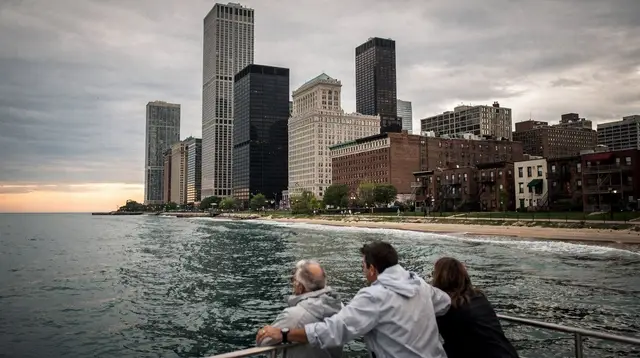
During the day, a Chicago River cruise is about architecture you can actually study — the setbacks on a Loop tower, the stone versus steel of a 1920s building next to a glass one from the 2000s. At night, most of that detail disappears into silhouette. What replaces it is a skyline lit from inside, window by window, plus the water doubling every light source as a rippled reflection. It’s a photogenic trip more than an educational one, and it draws a different crowd: couples, people avoiding the summer heat and crowds of daytime departures, and anyone with a camera who wants the skyline rather than the skyscraper.
Neither version is objectively better. If you want to actually understand what you’re looking at, take the daytime cruise. If you want the postcard shot and a quieter, more atmospheric hour on the water, the night departure is the one to book.
What you can and can’t see after dark
Expect these differences from the daytime experience:
- Building lighting, not building detail. Landmark towers like the Willis Tower are lit at night, often with color programs tied to events or seasons, but the architectural ornamentation that daytime guides point out — cornices, terra cotta, stone carving — is largely invisible.
- Reflections on the water. This is the payoff of the night cruise. Calm nights on the river turn every lit window into a long vertical smear of color on the surface, which is the shot most photographers are chasing.
- Reduced depth perception. Without daylight to show scale against the sky, some passengers find the skyline reads as flatter or more compressed at night. If height and scale are what impress you most, daytime wins.
- A quieter Riverwalk. The Chicago Riverwalk empties out earlier than the sidewalks of the Loop during the day, so boarding and disembarking tend to be calmer, with less foot traffic to navigate.
- Cooler, sometimes windy conditions. Evening air off Lake Michigan drops the temperature on the water noticeably compared to the same day’s afternoon heat, which is part of why some visitors prefer the night cruise in July and August.
What doesn’t change: the general route along the river, and on most operators, at least some live narration. If a fully silent, ambient ride matters to you, check the specific listing, since policies vary by operator and departure.
Getting to the dock and home again after dark
Most night departures leave from Riverwalk docks within easy walking distance of Loop transit, so a car isn’t necessary and parking downtown at night adds cost you can skip. The CTA’s “L” system keeps running into the evening, but service isn’t uniform across every line: only the Red Line and the Blue Line run 24 hours a day, while the rest of the system, including lines that serve parts of the Loop and North Side, stops overnight. If your night cruise lets out late, check which line gets you home before you rely on it, and load a Ventra card in advance so you’re not fumbling with fare machines on a dark platform. Our CTA and L train guide breaks down the full line map, and our broader getting around Chicago without a car guide covers rideshare and late-night options if your hotel isn’t near a station that runs all night.
If you flew in through O’Hare, the Blue Line connects directly to the airport and to the Loop, which makes it a reasonable way to bookend a first evening with a cruise before you’ve settled into a routine of taxis or rideshares.
Making a full evening of it downtown
A night cruise pairs naturally with the rest of downtown Chicago because so much of it is walkable from the Riverwalk and free to see after dark. Millennium Park and the Cloud Gate sculpture (“the Bean”) don’t charge admission and are lit and open into the evening, so a pre- or post-cruise walk over costs nothing but time. The Magnificent Mile along Michigan Avenue is a similarly easy add-on for window shopping or a meal before boarding; our Magnificent Mile walking tour guide lays out a route if you want structure rather than just wandering.
Navy Pier is another low-cost option to bracket the cruise with — entry to the pier itself is free, even though the rides and attractions inside charge separately — and it sits close enough to several Riverwalk docks to combine with a cruise without a long transit connection in between. If your evening includes dinner, the West Loop and Fulton Market area a short ride from the river has become one of the city’s denser restaurant districts, worth considering if you’d rather eat before or after the boat than treat the cruise itself as the whole night out.
None of this is necessary — a night cruise works perfectly well as a self-contained hour or so — but if you’re only in Chicago for a night or two and want to stack a car-free evening around the water, these are the pieces that connect without much extra planning.
Sunset timing swings hard across the year — and that matters here
Chicago sits in the Central time zone, observing CST in winter and CDT in summer, and its sunset time moves by several hours between the shortest and longest days of the year. That has a direct, practical effect on this specific cruise: the clock time that counts as a “night” departure in December is nowhere near the clock time that counts as one in June.
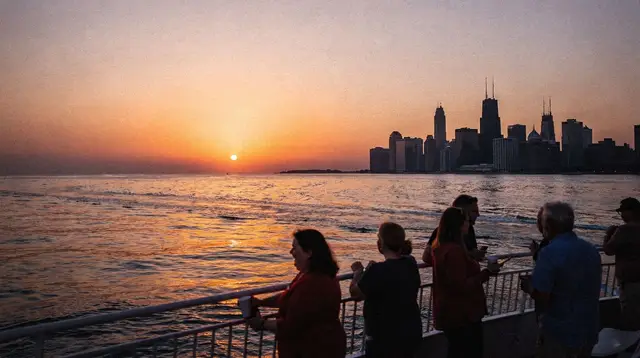
In deep winter, darkness falls in the late afternoon, so an evening cruise can leave well before a typical dinner hour and still be fully dark on the water. In midsummer, the sky stays lit long into the evening, so a cruise that departs at what feels like a normal early-evening time may still catch a lingering twilight rather than true darkness — closer to the golden hour experience than a fully lit-skyline one.
We’re not going to hand you a specific sunset time here, because it’s the wrong kind of fact to freeze on a page: it shifts every week of the year and depends on your exact travel date. What matters is the principle — check sunset for your actual dates before you pick a departure time, and don’t assume the same slot works in January and July. For the season-by-season case for when to visit Chicago at all, see our best time to visit Chicago guide.
If what you actually want is that in-between light — buildings still visible, sky still colored, before full dark — that’s a distinct product from this one. Our sunset river cruise guide covers the golden hour departure specifically, including how operators time it against the seasonal sunset swing.
Who this cruise is actually for
Couples. A slower boat, dimmer light and a skyline lit up for the occasion make this one of the more reliably romantic hour-long activities in the city. Several operators run evening departures with a cocktail or bar service built in, which leans further into that use case — see the sunset cocktail option below.
Photographers, amateur and otherwise. If you’re chasing the classic Chicago skyline shot with reflections in the river, this is the cruise, not the daytime one. A few practical notes: bring a camera or phone that handles low light reasonably well, since a tripod is impractical on a moving boat with other passengers around; a short-to-mid zoom covers most compositions, and you’ll want something wider once the boat gets close to the Loop bridges. For a broader look at where to shoot the skyline from land as well as water, see our best sunset skyline views guide, and for a dedicated on-water shoot, our Riverwalk couples photoshoot guide and skyline photoshoot guide cover options beyond a standard cruise ticket.
Anyone avoiding summer heat or daytime crowds. Chicago’s summer lakefront guide covers just how packed the riverfront and lakefront get on hot afternoons; an evening departure sidesteps most of that, at the cost of the architectural detail you’d get in daylight.
Not for: anyone whose main goal is learning the building-by-building history of the skyline — take the daytime cruise for that — and not for anyone looking for a Lake Michigan dinner cruise, which is a different product on open water rather than the river; that’s covered separately under lake cruises, not here.
Choosing a night departure
| Style | What it’s built for | Typical length |
|---|---|---|
| Standard evening architecture cruise | Lit skyline, general sightseeing after dark | 60–75 minutes |
| Sunset cocktail cruise | Couples, drinks on board, timed near sunset | 75–90 minutes |
| Speedboat evening cruise | Shorter, faster, more energetic pacing | 45–75 minutes |
| Historic vessel evening cruise | Slower pace, classic boat, calmer atmosphere | 90 minutes |
Prices vary by operator, boat, and whether a drink or narration is included; always confirm the current price and departure time on the operator’s own booking page before you commit, since both move seasonally.
A few ways to book a night departure:
For a date night with a drink built in, a guided river cruise timed near sunset with a cocktail on board covers the romantic end of this list directly. If you’d rather ride a classic vessel at a slower pace, an architecture cruise aboard Chicago’s First Lady is the more traditional boat option, often available with an evening departure. For a slightly longer ride with more time on the water, a 90-minute guided architecture boat tour gives you extra time for photos without changing the route dramatically. And if you’d rather move faster and cover more of the river in less time, a 75-minute speedboat architecture cruise is the higher-energy alternative to a standard sightseeing boat.
Practical notes for booking and boarding
- Layer up regardless of season. Wind off Lake Michigan and the river corridor drops the felt temperature at night more than daytime visitors expect, even in July.
- Boarding location matters more after dark. Riverwalk lighting is decent but not bright; confirm your dock and give yourself extra time to find it compared to a daytime departure.
- Winter evening cruises may pause entirely. Some operators reduce or suspend evening sailings in the coldest months; if you’re visiting in winter, check current seasonal schedules before building a night cruise into your plans, and see our winter activities guide for cold-weather alternatives.
- Getting there without a car is straightforward. The Riverwalk sits within walking distance of Loop transit; see our CTA and L train guide for getting downtown from wherever you’re staying.
- Pair it with a full day plan. If you want to build a single day around the river rather than just an evening slot, our one-day architecture river cruise itinerary sequences it against the rest of a Loop day.
- Compare cruise types before booking. If you’re still deciding between a river cruise, a walking tour, or a different time of day, the broader architecture river cruises category lays out every option side by side, and our architecture cruise vs walking tour guide is worth a look if you’re torn between water and land.
- Don’t confuse this with a lake cruise. If open-water views of the skyline from Lake Michigan, or a full dinner service, are what you actually want, look at the Lake Michigan cruises category instead — different water, different boats, different focus.
Night architecture river cruise FAQ
Is the night architecture cruise the same route as the daytime cruise?
Operators generally run the same stretch of the Chicago River, from the Riverwalk through the Loop and toward the lake. What changes is what you can see and how the buildings are lit, not the geography of the route.
Can I still hear the architecture commentary on a night cruise?
Most night departures keep live or recorded narration, but some operators trim it in favor of a quieter, more atmospheric ride. Check the specific listing before booking if commentary matters to you.
What time does the night cruise leave in summer versus winter?
Departure times track sunset, which swings by several hours across the year in Chicago’s Central time zone. Summer evening cruises leave much later than winter ones; always check the live schedule for your travel dates rather than assuming a fixed hour.
Do I need a zoom lens or tripod for photos on a night cruise?
A tripod is impractical on a moving, often crowded boat, so a camera or phone that handles low light well matters more. A short to mid zoom covers most skyline shots; a wide lens helps once the boat is close to the Loop bridges.
Is the night cruise colder than the daytime cruise?
Evening temperatures drop noticeably on the water, even in summer, because of wind off Lake Michigan and the river corridor. Bring a layer regardless of season; winter evening departures are cold enough that some operators pause the season entirely.
Should I book the golden hour or the fully dark departure?
That depends on what you want to see: golden hour shows the skyline in warm light with some detail still visible, while a fully dark departure is about the lit buildings and reflections. See our dedicated golden hour guide for that specific choice.
Is this the same as a Lake Michigan dinner cruise?
No. This is a river-based architecture cruise on the Chicago River, focused on the skyline and bridges. Dinner cruises run on Lake Michigan itself and are a different product with a different focus.
Chicago River architecture and sightseeing cruises on GetYourGuide
Verified deep-linked GetYourGuide tours. Book through these links and we earn a small commission at no cost to you.
GetYourGuide does not provide a product photo for this activity — the image shows the meeting point, photographed by us.