Free and cheap things to do in Chicago
Can you enjoy Chicago without paying for observation decks and museum tickets?
Yes. The Chicago Riverwalk, Millennium Park and Cloud Gate, several skyline viewpoints along the lakefront, and neighborhoods like Wicker Park and Pilsen cost nothing to walk through. Add a handful of free museum days and the lakefront beaches, and a full trip can lean heavily on no-cost or low-cost activities.
What actually costs nothing in Chicago
Chicago’s reputation runs on ticketed attractions: the Skydeck, the Museum Campus, the architecture river cruises. Those are worth the money for a lot of visitors, and this site covers each of them in detail elsewhere. But a good chunk of what makes the city worth visiting doesn’t require a ticket at all — it requires a decent pair of shoes and, in winter, a real coat.
This page is a rundown of the no-cost and low-cost side of Chicago: places where the street itself is the attraction, viewpoints that don’t require an elevator, and museum days that come without a price tag. None of it replaces the paid attractions covered in things to do, it fills the space around them.
Walk the Chicago Riverwalk for free
The Chicago Riverwalk runs along the south bank of the Chicago River through the Loop, and simply walking it costs nothing. You get sightlines up at the skyscrapers lining the river, public art, seating, and access points at nearly every bridge. Restaurants and bars along the path charge normal prices, and the architecture boat cruises that depart from the docks here are a separate paid activity, but the walk itself is open to anyone at no charge during its operating hours.
For a full rundown of the path’s length, access points, and what’s along it, see the dedicated Chicago Riverwalk guide. If a boat cruise interests you later, architecture river cruises covers the paid options that depart from the same stretch.
Free skyline views, without an observation deck
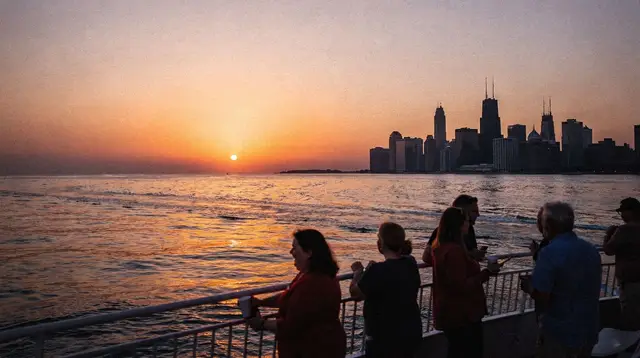
Paying for the Skydeck at Willis Tower or 360 Chicago at 875 North Michigan Avenue gets you height, glass floors, and a weatherproof platform. It’s not the only way to see the skyline. Several points along the lakefront — north of the Museum Campus, and stretches of the Lakefront Trail near the Loop — give unobstructed views of the skyscraper cluster rising against the lake, at no cost and with no line.
The specific spots that work best by time of day, including the ones favored for sunset, are laid out in best sunset views of the Chicago skyline. That guide goes deeper on this exact angle than is useful to repeat here — worth reading before you plan an evening around it.
Millennium Park and Cloud Gate cost nothing
Millennium Park, in the Loop, has no admission fee. That includes Cloud Gate — the reflective sculpture known locally as “the Bean” — Crown Fountain, and the park’s public lawns and gardens. The Jay Pritzker Pavilion hosts free daytime access to its grounds, though some evening concerts inside are ticketed events.
The Art Institute of Chicago, directly adjacent, is a paid museum — expect somewhere in the range of 30 USD for an adult ticket, though the exact figure and any local free days should be confirmed at artic.edu rather than taken from this page. Millennium Park itself, though, is free every day, year-round.
Loop architecture, on foot, for free
The Loop’s streets are lined with buildings from the era that gave Chicago its reputation as the birthplace of the skyscraper: work by Louis Sullivan, Daniel Burnham, and later Ludwig Mies van der Rohe. Walking these blocks and looking up costs nothing. A guided walk adds historical context and a route that hits the significant buildings in order, which is the value proposition of classic Loop skyscrapers walking tour and the broader Chicago Loop walking tour guide — both optional, neither required to see the buildings themselves.
Neighborhoods where the street is the attraction
Several Chicago neighborhoods reward simply walking through them, with murals, storefronts, and streetscape doing the work that a paid attraction does elsewhere.
Wicker Park and Bucktown, on the North Side, mix independent shops, restaurants, and a dense concentration of street art and murals across a walkable grid. The Wicker Park and Bucktown neighborhood guide lays out a self-guided route.
Pilsen, on the South Side, has one of the city’s most significant concentrations of Mexican-American mural art, much of it along 16th Street and around the National Museum of Mexican Art (which itself has no general admission charge). See the Pilsen neighborhood mural tour guide for a walking route.
Logan Square and Andersonville, both on the North Side, offer similar low-cost wandering: independent businesses, residential architecture, and a slower pace than downtown. None of these neighborhoods charge for entry or require a guide — the street itself is public and free.
If murals specifically are the draw, offbeat street art tour Chicago covers the citywide picture, and a guided version exists as a small-group street art walking tour through some of the city’s best mural blocks for travelers who’d rather not plan the route themselves.
The lakefront and beaches: free access, seasonal swimming
Lake Michigan is a freshwater lake, not an ocean, and its shoreline in Chicago is public land for its entire urban length. The city’s municipal beaches have no entry fee at any time of year, and the shore itself — sand, paths, benches — is open to walk along whenever it’s accessible.
Lifeguard supervision, however, runs only from late May to early September. Outside that window the beaches remain open and free to walk, but swimming is unsupervised. The roughly 30-kilometer Lakefront Trail that runs along this shoreline is itself a free, year-round path for walking, running, or biking, and a guided version of the biking angle exists as a walking tour that includes complimentary bike and kayak time along the water if you’d rather not rent gear separately. For the seasonal picture in more depth, see Chicago summer lakefront guide.
Navy Pier: free to enter
Navy Pier charges no admission to enter the pier itself and walk its length. The Centennial Wheel, indoor museums, and most shows inside are priced separately and vary by season — check navypier.org for current pricing before assuming a specific figure.
Free or reduced museum days
Some Chicago museums run periodic free or discounted admission windows, often limited to Illinois residents, specific weekdays, or evening hours. These change from year to year and by institution, so this page won’t quote a specific schedule. If a paid museum visit is part of your plan regardless, check the current calendar at the museum’s own site — artic.edu, fieldmuseum.org, sheddaquarium.org, or adlerplanetarium.org — before you go. For the Museum Campus specifically, museum campus tours guide and Art Institute of Chicago fast pass guide cover the paid side in detail.
Lincoln Park Zoo and the North Side, free
Lincoln Park, on the North Side, is anchored by Lincoln Park Zoo, one of the few zoos in the country with no admission charge at all — daily, year-round. Combined with a walk through neighboring Old Town, an afternoon here costs nothing beyond food and transit. The Old Town and Lincoln Park walking tour guide lays out a fuller route through both, including Old Town’s comedy-club history. Farther north, Andersonville and Logan Square, mentioned above, round out a string of North Side neighborhoods that reward walking without any admission fee at all.
Hyde Park and the South Side, free to explore
On the South Side, Hyde Park centers on the University of Chicago, whose Gothic quads, chapel exterior, and the Midway Plaisance are open, public, and free to walk through — a legacy of the 1893 World’s Columbian Exposition, whose “White City” once stood in nearby Jackson Park. The Hyde Park university walking tour guide lays out a self-guided route through campus and the surrounding blocks. The Museum of Science and Industry, also in Hyde Park, is a paid museum — its building is one of the few structures to survive from the 1893 fair, but stepping inside still costs a ticket. For the fuller South Side picture beyond Hyde Park, Hyde Park and South Side covers Bronzeville, Pilsen, and Chinatown, where walking the commercial strip and side streets costs nothing beyond whatever you choose to eat along the way.
Oak Park: Frank Lloyd Wright’s work without a ticket
Oak Park, just west of the city, is where Frank Lloyd Wright built his early career and where Ernest Hemingway grew up. The Frank Lloyd Wright Historic District includes dozens of homes he designed, and walking the streets to see their exteriors costs nothing — only stepping inside the Home and Studio or one of the house museums requires admission. Oak Park Frank Lloyd Wright museums guide covers which interiors are worth the ticket, and Oak Park family day guide works the free exterior walk into a fuller day out. Getting there and back without a car is its own small planning question, and a guided option exists as a scenic driving tour that takes in Oak Park’s architecture alongside other Chicago-area sights for travelers who would rather skip the transit connections.
Holiday season: free lights and window displays
In the weeks around Christmas, the Loop and Michigan Avenue add a free layer of things to see: light displays, department-store window installations along the Magnificent Mile, and the outdoor stalls of the Christkindlmarket, all free to walk through, though food and drink bought there are priced individually. Chicago Christmas holiday guide covers the full seasonal calendar, and a guided version of the walk exists as a holiday-season walking tour through the Loop’s lights and decorations for a narrated version of the same free displays.
Cheap day trips beyond the city
Not every day trip from Chicago runs up a bill. Galena and Starved Rock State Park, both within Illinois, cost nothing to enter beyond typical park or parking fees, and hiking Starved Rock’s canyons and overlooks is a free activity once you’re there — see Starved Rock and Galena day trip guide for the specifics. Milwaukee, across the state line in Wisconsin, is roughly 90 minutes away by car or by the Amtrak Hiawatha from Union Station; walking its lakefront and downtown costs nothing beyond the transportation itself, covered in the Milwaukee day trip from Chicago guide.
Free vs. paid, at a glance
| Activity | Free version | Paid alternative |
|---|---|---|
| Chicago Riverwalk | Walk the path, any time it’s open | Architecture boat cruise from the same docks |
| Skyline views | Lakefront Trail, park viewpoints | Skydeck (Willis Tower) or 360 Chicago (875 N. Michigan Ave) |
| Millennium Park | Cloud Gate, Crown Fountain, the lawns | Art Institute of Chicago, next door |
| Loop architecture | Self-guided walk, look up | Guided skyscraper walking tour |
| Wicker Park, Pilsen murals | Self-guided walk | Guided street art or neighborhood tour |
| Lake Michigan | Beach access, walking the shore | None needed — swimming is free too, seasonally |
| Navy Pier | Enter and walk the pier | Centennial Wheel, indoor attractions |
Where a paid pass still makes sense
None of the above replaces the paid attractions that anchor most Chicago itineraries — the Skydeck, the Museum Campus, an architecture cruise. What free activities do well is fill the time between those bookings without adding cost: an afternoon in Wicker Park before an evening cruise, a lakefront walk instead of a second paid viewpoint, a Loop architecture stroll before a museum visit down the block.
If your trip does include several paid museums and attractions, a combined pass can lower the per-ticket cost compared with buying each one separately. The tradeoffs — which pass, whether it pays off for a shorter trip — are covered in budget Chicago CityPASS guide, which is the right next stop if pass economics is what you’re weighing rather than free activities on their own.
For a full day built mostly around no-cost stops, budget Chicago itinerary sequences several of the activities above into a single walkable day. And for getting between neighborhoods without a car, getting around Chicago without a car and the CTA “L” train guide cover the transit side — Ventra fares are a modest, unavoidable cost, but far cheaper than parking downtown.
Free and cheap things to do in Chicago: FAQ
Is Millennium Park really free?
Yes. Millennium Park, including Cloud Gate (the Bean), Crown Fountain, and the Jay Pritzker Pavilion lawn during most daytime hours, has no admission charge. Only ticketed evening concerts and special events inside the park cost money.
Can I swim in Lake Michigan for free?
Chicago’s municipal beaches are free to enter year-round, but they are only staffed with lifeguards from late May to early September. Outside that window the beach itself stays open and free, but swimming is unsupervised and not recommended.
Are there free days at the Art Institute or the Museum Campus?
Some Chicago museums offer periodic free or discounted admission for residents of Illinois, often on specific weekdays or evenings. These vary by institution and change from year to year, so check artic.edu, fieldmuseum.org, sheddaquarium.org, and adlerplanetarium.org directly before planning around one.
Is walking through Wicker Park or Pilsen free, or do I need a tour?
Walking the streets, looking at the murals, and browsing storefronts in Wicker Park, Pilsen, or Logan Square costs nothing. A guided walking or street art tour is optional and adds context, transportation between sites, and a local narrator, but it is not required to see the neighborhoods.
Does Navy Pier charge an entry fee?
No. Navy Pier itself is free to enter and walk around. The Centennial Wheel, indoor attractions, and most shows inside the pier are priced separately.
What is the cheapest way to see the Chicago skyline?
Free lakefront viewpoints and the Riverwalk give skyline views without any ticket. Paying for the Skydeck at Willis Tower or 360 Chicago at 875 North Michigan Avenue buys height and an indoor, weatherproof platform, which is a different experience, not a strictly better one.
Is the Chicago Riverwalk free to walk?
Yes, the Riverwalk along the south bank of the Chicago River in the Loop is a public, free path at all hours it is open. Only the boat cruises that depart from it, and some riverside restaurants, involve a cost.
Do the city’s free activities work well with a multi-attraction pass?
They complement one, rather than compete with it. Free walks and viewpoints fill the gaps between paid museum visits or cruises, which is how a combined pass tends to pay off fastest.
Tours for your first trip to Chicago on GetYourGuide
Verified deep-linked GetYourGuide tours. Book through these links and we earn a small commission at no cost to you.
GetYourGuide does not provide a product photo for this activity — the image shows the meeting point, photographed by us.