First-time visitor guide to Chicago
What does a first-time visitor to Chicago need to know before arriving?
Chicago has two airports (O'Hare and Midway), runs on Central time with a seasonal clock change, and its elevated train network, the L, only runs 24 hours a day on the Red and Blue lines. Lake Michigan is a freshwater lake, not the ocean, and its beaches are only lifeguarded from late May to early September.
Getting your bearings before you land
Chicago is the third-largest city in the United States, sitting in the state of Illinois on the southwestern shore of Lake Michigan. The city itself, within its official limits, holds around 2.7 million people. That’s a different number from “Chicagoland,” the wider metropolitan area, which runs to roughly 9.4 million — a distinction worth keeping straight, because guidebooks and locals use both loosely. If a trip planner or listing mentions somewhere in “Chicagoland,” it may well be a suburb 30 kilometers (about 19 miles) from downtown, not a neighborhood you can walk to.
This guide covers the practical layer underneath your trip: airports, time zone, transit basics, the lake, and money. For a specific day-by-day plan, see the 3-day Chicago itinerary guide; this page is the reference you keep open alongside it.
Two airports, and they’re not interchangeable
Chicago is served by two airports, and which one you land at changes your first hour in the city.
| Airport | Location | Transit line | Approx. time to the Loop |
|---|---|---|---|
| O’Hare (ORD) | Northwest of downtown | CTA Blue Line | 40 to 45 minutes |
| Midway (MDW) | Southwest of downtown, closer in | CTA Orange Line | 25 to 30 minutes |
O’Hare is by far the busier of the two and the one most international flights use. Midway is smaller, generally handles more domestic and budget carriers, and sits closer to downtown. Neither airport requires a taxi or rideshare to reach the city center — both connect directly to the L, Chicago’s elevated train system, run by the CTA (Chicago Transit Authority). You’ll want a Ventra card or the Ventra app to pay the fare; it also works on buses and the Metra suburban rail. For the full walkthrough of routes, fares and luggage logistics, see getting from O’Hare to downtown Chicago and, more broadly, getting around Chicago without a car.
Time zone: Central, and it does change
Chicago runs on Central time: Central Standard Time (CST, UTC-6) in winter, Central Daylight Time (CDT, UTC-5) in summer. The clocks shift on the same schedule as most of the US — forward on the second Sunday of March, back on the first Sunday of November. If your trip straddles one of those dates, or if you’re coordinating calls home, build in the one-hour shift rather than assuming Chicago stays put year-round the way some destinations do.
The L: fast, extensive, but not all-night
Chicago’s rapid transit system is called the L (short for “elevated,” even though parts of it run underground and at street level). It’s operated by the CTA across eight color-coded lines plus an extensive bus network, and it’s the backbone of getting around without a car.
The detail that trips people up: only the Red Line and the Blue Line run 24 hours a day. Every other line — Brown, Green, Orange, Pink, Purple, Yellow — stops overnight and starts back up in the morning. If your evening plans (a blues club, a late dinner in Fulton Market, a show) end after midnight and you’re not near the Red or Blue line, factor in a rideshare or a longer walk. The full rundown of lines, fares, and how Ventra works is in the CTA L train guide.
For trips out to the suburbs — Oak Park, Evanston, Naperville — the commuter rail system is Metra, a separate network from the L. Metra’s weekday schedule is fairly frequent; weekend service drops off noticeably, so check metrarail.com for the specific line before planning a Saturday day trip. For short downtown hops in decent weather, Divvy, the city’s bike-share system, is a reasonable option — pricing is per-ride or by pass, and it’s worth checking current rates on divvybikes.com before assuming a flat cost.
Downtown geography: the Loop, the river, the Mile
Central Chicago breaks into a few zones that are useful to know by name before you arrive:
- The Loop is the historic core, named for the loop the elevated tracks make around it. This is where you’ll find Millennium Park, the Willis Tower, and the Art Institute of Chicago.
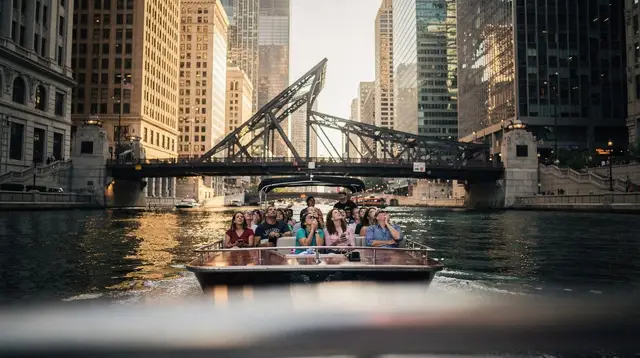
- The Riverwalk runs along the south bank of the Chicago River through downtown and is the starting point for most architecture river cruises — one of the most consistently well-reviewed things to do in the city.
- Michigan Avenue and the Magnificent Mile form the shopping corridor north of the river, running up toward Oak Street, flanked by the Streeterville and River North neighborhoods.
- The West Loop and Fulton Market, just west of the Loop proper, are Chicago’s fastest-growing restaurant district.
A guided walk is a genuinely efficient way to get this geography straight on day one. A walking tour through the Loop’s neighborhoods covers a lot of this ground with someone who can point out what’s worth a return visit. If architecture specifically is why you came, an architecture-focused walking tour of the city’s landmark buildings is a strong first-day pick, since Chicago’s skyline is genuinely the reason the city’s architecture school (Sullivan, Burnham, later Mies van der Rohe) became a global reference point.
Two towers, two companies, one common mix-up
If you’re planning to go up for a view, know this before you book: the Skydeck (with its glass balconies, The Ledge) is inside the Willis Tower, at 233 South Wacker Drive in the Loop — the building was called the Sears Tower until 2009. The 360 Chicago observation deck, with its tilting TILT platform, is a separate attraction entirely, at 875 North Michigan Avenue on the Magnificent Mile — that building was the John Hancock Center until 2018. They’re run by different companies, sit more than 2 kilometers apart, and neither one includes the other’s ticket. Both hover around USD 30 to 35 for a standard adult ticket, before add-ons, and both prices change by season — check theskydeck.com and 360chicago.com directly before you go. Full comparisons live in the Skydeck and Willis Tower guide, the TILT and 360 Chicago guide, and a side-by-side Skydeck comparison.
The lake is a lake, not the ocean
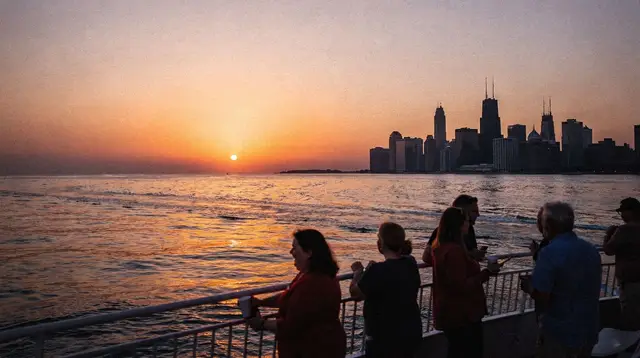
Lake Michigan is freshwater, and it behaves like a large lake rather than an ocean — no tides, no salt, but it can still produce real waves and strong currents. Chicago’s municipal beaches are free and lifeguarded, but only from late May to early September; outside that window, the beaches are still there but unsupervised. The Lakefront Trail, a roughly 30-kilometer path along the shore, is usable year-round for walking or biking and connects many of downtown’s best views of both the water and the skyline.
Millennium Park and its centerpiece sculpture, Cloud Gate — universally nicknamed “the Bean” — are free, no ticket required. The Art Institute of Chicago, a short walk away, is not; expect around USD 30 for an adult ticket, and check artic.edu for the current price and any local free-admission days. Further south, the Museum Campus groups three separately ticketed institutions — the Field Museum, the Shedd Aquarium, and the Adler Planetarium — each with its own admission (or a combined pass, like Chicago CityPASS, if you’re visiting more than one). Navy Pier itself is free to enter; the rides and attractions inside it are billed separately. Details for all of these are in the museum campus tours guide.
What it actually costs
Chicago’s prices are quoted before tax, and the taxes add up faster than in many US cities. The general sales tax on goods runs around 10% — one of the higher rates among major US cities — and it shifted again during 2026, so treat any exact figure as provisional rather than fixed. Hotel stays carry a separate, heavier lodging tax that stacks city, county, state, and special-district charges; depending on the property’s location, that typically lands around 17 to 19% on top of the room rate, and downtown rates were revised upward again in 2026. Budget for both, and check chicago.gov for the number in effect on your travel dates rather than trusting a number printed a year ago. Restaurant tipping follows the usual US pattern, roughly 18 to 22%.
If cost is a driving factor in your planning, the free and cheap things to do in Chicago guide is worth reading before you book anything — Millennium Park, the Riverwalk, and several neighborhoods cost nothing to enjoy properly.
When to come
Chicago’s seasons are pronounced. Winter (December through February) is cold and windy, with daytime highs commonly around 0°C and colder overnight — this is also where the “Windy City” nickname earns its keep, helped by the corridor effect between downtown’s towers and the open lake. Summer (June through August) runs warm and humid, typically 25 to 28°C by day, and is the city’s high season for lakefront life and beach weather. Spring arrives late; autumn is frequently cited as the most comfortable season to visit, with milder temperatures and thinner crowds. These are broad NOAA-based patterns for the O’Hare station, not fixed averages, so pack in layers regardless of season. The full seasonal breakdown, including festival timing, is in the best time to visit Chicago guide.
A little history that explains what you’ll see
Chicago’s built environment makes more sense with some background. The Great Chicago Fire of October 1871 destroyed much of the city, and the rebuilding that followed effectively invented the modern skyscraper — a direct line to why architecture tours are such a fixture here today. The World’s Columbian Exposition of 1893, held at Jackson Park on the South Side, drew more than 27 million visitors and left a permanent mark on American architecture and city planning.
The 1920s brought Prohibition and the enduring, heavily marketed legend of Al Capone, which fuels a whole category of gangster-themed tours around downtown. The Great Migration of the 20th century reshaped the South Side and gave rise to Chicago’s electric blues scene, still audible in clubs across the city. And the Chicago School of architecture — Louis Sullivan, Daniel Burnham, later Ludwig Mies van der Rohe — plus Frank Lloyd Wright’s early work in nearby Oak Park, is why this city, more than most, rewards looking up.
Beyond downtown, without overcomplicating day one
You don’t need to plan every neighborhood before arriving, but it helps to know the shape of the city: Lincoln Park and Wrigleyville to the north, Hyde Park and the Museum of Science and Industry to the south, and a ring of accessible day trips beyond the city limits — Oak Park for Frank Lloyd Wright and Hemingway, Starved Rock State Park and Galena within Illinois, the Indiana Dunes just across the state line, and Milwaukee, which is in Wisconsin, not a Chicago suburb, about 1.5 hours away by car or by the Amtrak Hiawatha train from Union Station.
If a full day exploring the wider city rather than just downtown appeals to you, a full-day guided city tour by bus is a low-effort way to cover more ground on limited time, and a private, custom tour with a local guide lets you weight the day toward whatever you actually came for — architecture, food, history, or the lake. For something less conventional on the water, a guided sunset kayak tour on the Chicago River gives you the skyline from an angle most first-time visitors never see.
A short first-timer’s checklist
- Confirm which airport you’re flying into and check the L line that meets it.
- Get a Ventra card or app loaded before your first ride.
- Note that only the Red and Blue lines run overnight — plan late nights accordingly.
- Check the sales tax and hotel tax rates for your travel dates at chicago.gov; don’t assume last year’s number.
- Decide whether you’re going up the Willis Tower’s Skydeck, the 360 Chicago’s TILT, or both — they’re different buildings and different tickets.
- If visiting May through September, pack for the beach; outside that window, the lakefront is for walking, not swimming.
- Leave room for at least one day trip if your schedule allows — Oak Park is the easiest, being a short ride from downtown.
Common questions from first-time visitors to Chicago
Which Chicago airport should I fly into?
Either works, but they’re different. O’Hare (ORD) is the larger, busier airport northwest of downtown, reached by the Blue Line in about 40 to 45 minutes. Midway (MDW) is smaller and closer, southwest of downtown, reached by the Orange Line in about 25 to 30 minutes. If you have a choice and no strong price difference, Midway saves time getting downtown.
What time zone is Chicago in?
Chicago is in the Central time zone: Central Standard Time (CST, UTC-6) in winter and Central Daylight Time (CDT, UTC-5) in summer. Like most of the US, Chicago changes its clocks, springing forward the second Sunday of March and falling back the first Sunday of November.
Does the Chicago L train run all night?
No. Only the Red Line and the Blue Line run 24 hours a day. Every other L line stops overnight and resumes service in the morning, so plan late-night trips around those two lines or budget for a rideshare.
Can you swim in Lake Michigan in Chicago?
Yes, but only in season. Lake Michigan is a freshwater lake, not an ocean, and Chicago’s municipal beaches are lifeguarded and officially open from late May to early September only. Outside that window, swimming isn’t supervised.
Are prices in Chicago shown with tax included?
No. Listed prices for shopping and attractions are pre-tax. Chicago’s general sales tax runs around 10%, and hotel stays carry an additional lodging tax that can add up to roughly 17 to 19% on top of the room rate, depending on the property’s location — always check the current rate at chicago.gov before budgeting.
Is Chicago walkable for a first visit, or do I need a car?
Downtown Chicago (the Loop, the Magnificent Mile, River North, the West Loop) is very walkable and well connected by the L, so most first-time visitors don’t need a car. A car becomes useful mainly for day trips like Starved Rock or Galena, which aren’t served by train.
How many days do I need for a first trip to Chicago?
Three to four days covers the core sights — downtown, the lakefront, one museum, one neighborhood beyond downtown — at a comfortable pace. Two days is workable if you focus tightly on downtown.
Tours for your first trip to Chicago on GetYourGuide
Verified deep-linked GetYourGuide tours. Book through these links and we earn a small commission at no cost to you.
GetYourGuide does not provide a product photo for this activity — the image shows the meeting point, photographed by us.