A three-day Chicago itinerary organized by zone, not by hour
What's the best way to structure three days in Chicago?
Give each day one geographic zone instead of a fixed hourly schedule: day one for the Loop and the river, day two for the lakefront and Museum Campus, day three for a local neighborhood like Old Town, Lincoln Park, or Wicker Park. That order keeps walking distances short and leaves room to slow down.
Why zones work better than a fixed hourly schedule
Most three-day Chicago plans online read like a spreadsheet: 9 a.m. this, 11 a.m. that, lunch at exactly noon. That kind of schedule breaks the first time a train runs late, a line is longer than expected, or the wind off Lake Michigan makes you want to duck indoors. It also assumes you’ll walk in a straight line across a city where the Loop, the lakefront, and the North Side neighborhoods are genuinely different distances apart.
A more durable way to plan three days is by zone. Give one day to the Loop and its cluster of architecture and river views, one day to the lakefront and the Museum Campus, and one day to a single local neighborhood rather than a scattershot tour of five. Inside each day, sequence activities loosely by proximity rather than by clock time. This guide sets up that framework and points you to the guides and category pages that go deep on each piece — it doesn’t try to replace them, and it isn’t a substitute for the general prep covered in the first-time visitor guide, which handles packing, safety, and money questions rather than a day-by-day sequence.
If you’re arriving from overseas, note that Chicago runs on Central Time — CST (UTC-6) in winter, CDT (UTC-5) in summer — and observes the clock change on the second Sunday of March and the first Sunday of November. Build in a slower first afternoon if your flight crosses more than five or six time zones; trying to hit the Loop hard on day one after an overnight flight from Europe or Asia usually backfires.
Before day one: where you land shapes where you start
Chicago has two airports, and which one you fly into has a small but real effect on your itinerary’s logic. O’Hare (ORD), in the northwest, is served by the CTA Blue Line, with a ride of roughly 40 to 45 minutes into the Loop. Midway (MDW), in the southwest and closer to downtown, is served by the Orange Line, at roughly 25 to 30 minutes. Both trains run directly into downtown without a transfer, which makes either airport a reasonable first stop for a Loop-based hotel.
The CTA “L” is Chicago’s elevated and subway rail network. Only the Red Line and the Blue Line run 24 hours a day; every other line stops overnight and resumes in the morning, so a late arrival on an Orange or Brown Line route may mean a bus or rideshare for the last leg. Load a Ventra card or the Ventra app before or right after landing — it covers the L, buses, and (with a separate fare structure) Metra commuter trains to the suburbs.
If your flight lands in the afternoon or evening, treat the rest of that day as arrival, not day one. Check in, get a Ventra card sorted, and if you have energy, take a short walk along the Riverwalk rather than starting the full Loop day tired.
Day one: the Loop and the river
Base the first full day around the Loop, Chicago’s historic downtown core, named for the elevated tracks that ring it. This is where the city’s architecture story is easiest to see in a single walk: Millennium Park and the Cloud Gate sculpture (locally “the Bean”), a free public artwork with no ticket required, sit at the Loop’s edge, and the Art Institute of Chicago — a paid museum, roughly 30 USD for an adult ticket, though it’s worth checking artic.edu for the current price and any local free days — anchors its south side.
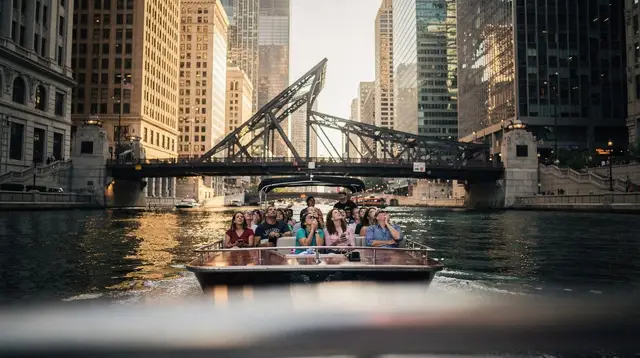
The single most useful orientation activity for a first Chicago day is a river architecture cruise. The Chicago Riverwalk is where most of these depart, and seeing the skyline from the water — with a guide explaining what you’re looking at — makes every building you pass on foot afterward make more sense. For a walking-focused alternative or a follow-up the same afternoon, a guided architecture walk through the Loop covers similar ground street level: a guided walk past the Loop’s landmark skyscrapers is a solid anchor for the morning, and a small-group walking tour through the Loop’s core blocks works well as a shorter afternoon option if you’d rather split the day.
Two observation decks sit within or near the Loop, and it’s worth being precise about them because they’re frequently confused: the Skydeck, with its glass-floor Ledge balconies, is inside the Willis Tower at 233 South Wacker Drive, in the Loop itself. The 360 Chicago observation deck and its TILT platform are a separate operation at 875 North Michigan Avenue on the Magnificent Mile, over 2 km away. They’re run by different companies with separate tickets — the Willis Tower was called the Sears Tower until 2009, and 875 North Michigan was the John Hancock Center until 2018, and both older names still turn up in search results and guidebooks. Pick one for day one if you want a skyline view; the other fits more naturally into day two, since it sits closer to the lakefront route.
End day one in River North or Fulton Market for dinner — both sit just west and north of the Loop and are an easy walk or short L ride from wherever your afternoon left off.
Day two: the lakefront and the Museum Campus
Chicago’s identity is tied to Lake Michigan, and day two is built around it. Lake Michigan is a freshwater lake, not an ocean, and its municipal beaches are free but staffed with lifeguards only from late May to early September — outside that window, swimming isn’t supervised. The Lakefront Trail runs roughly 30 km along the shore, and even a short stretch of it, on foot or by rented Divvy bike, gives a sense of how the city faces the water.
The Museum Campus, just south of Grant Park, groups three separately ticketed institutions: the Field Museum, the Shedd Aquarium, and the Adler Planetarium. Each charges its own admission — there’s no single combined entry — so pick one or two rather than trying for all three in an afternoon, unless you’re using a multi-attraction pass like Chicago CityPASS, covered in the pass comparison guide. Prices vary by season and residency, so treat any number here as a starting point and check fieldmuseum.org, sheddaquarium.org, or adlerplanetarium.org directly before you go.
Navy Pier, a bit north along the lake, is free to enter — its Ferris wheel, museums, and shows inside are each priced separately. It’s a reasonable stop to bridge the Museum Campus and a return toward the Magnificent Mile, though it leans touristy and crowded in peak summer months; budget-conscious travelers may prefer more time on the Lakefront Trail itself.
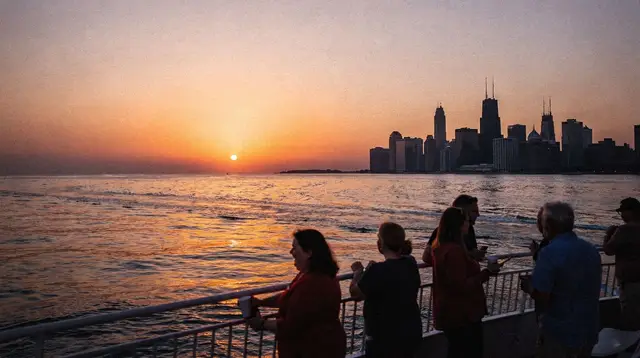
If the weather cooperates, an on-water activity fits naturally into this day rather than the first. A guided sunset kayak trip along the river gives a different angle on the skyline than the architecture cruise, best scheduled for early evening once the Museum Campus visit wraps up.
Day three: pick one neighborhood, not five
The mistake in a lot of Chicago itineraries is trying to sample every neighborhood in a single afternoon. A better use of a third day is choosing one area and actually walking it. Lincoln Park and Old Town work well for this: Lincoln Park has a genuinely free zoo, Old Town carries the Second City comedy legacy, and both sit close enough together to cover on foot, with Lakeview and Wrigleyville a short extension north if you want to see Wrigley Field from outside. A guided walk through Old Town and Lincoln Park’s historic blocks is a good way to structure this without over-planning it — see the Old Town and Lincoln Park walking guide for route detail.
Wicker Park and Logan Square, further northwest, offer a different flavor — record shops, murals, a younger restaurant scene — and are reachable by the Blue Line if that fits your route better than Lincoln Park’s.
For a genuinely different day three, consider Hyde Park on the South Side: the University of Chicago campus, the Museum of Science and Industry, and a neighborhood that sees far fewer first-time visitors than the North Side, despite being one of the city’s architecturally richest areas. It’s a longer ride from the Loop than Lincoln Park, so it works best as a half-day plus museum visit rather than a full afternoon of neighborhood wandering.
If none of the above appeals and you’d rather see a wide slice of the city in one guided sweep instead of choosing a single neighborhood, a
full-day guided bus tour covering multiple neighborhoods is a reasonable trade-off for a shorter trip, though it moves faster and covers less depth than picking one area on foot.
Where day trips and the suburbs fit
None of the destinations below belong inside the three-day city framework — they’re additions, not substitutes for a day in it. Oak Park, Ernest Hemingway’s hometown and home to a cluster of Frank Lloyd Wright’s early “prairie style” houses including his own home and studio, is close enough to add as a half-day extension by CTA without needing a car.
Longer day trips need a full extra day and, in most cases, a car. Milwaukee is in Wisconsin, not Illinois — worth stating plainly, since it’s often mistaken for a Chicago suburb — and sits about 1.5 hours away by car or by the Amtrak Hiawatha train from Union Station. Starved Rock State Park and Galena are both in Illinois: Starved Rock is roughly 90 miles (150 km) southwest of the city, about 1.5 to 2 hours by car, with no direct train service, so it requires driving. Indiana Dunes National Park, about 45 miles (70 km) southeast in Indiana, is reachable by the South Shore Line train rather than CTA or Metra. Lake Geneva (Wisconsin) and Mackinac Island (Michigan) are two more classic day-trip options but sit outside Illinois entirely and require more travel time than the destinations above.
A private guide can help stitch a day trip and a city day together without wasted transit time — see the private custom tour option if that flexibility matters more to you than cost, via a private, custom-paced tour with a local guide that can be built around whichever zone or day trip you haven’t covered yet.
The three days at a glance
| Day | Zone | Anchor activities | Best transit |
|---|---|---|---|
| Day 1 | The Loop and the river | Millennium Park, Cloud Gate, Art Institute, river architecture cruise, Skydeck or 360 Chicago | Walking, Blue or Red Line |
| Day 2 | The lakefront and Museum Campus | Lakefront Trail, one or two Museum Campus museums, Navy Pier | Walking, Divvy bike, bus |
| Day 3 | One local neighborhood | Lincoln Park and Old Town, Wicker Park, or Hyde Park | Red, Brown, or Blue Line depending on choice |
Prices throughout Chicago are quoted before tax. The city’s general sales tax runs around 10.25 percent as of 2026, among the highest of any major U.S. city, and it has moved before — check the current rate at chicago.gov rather than treating any figure here as fixed. Hotel stays carry a separate, steeper lodging tax that stacks city, county, and state layers and runs roughly 17 to 19 percent depending on the property’s location, revised upward in parts of downtown in 2026. Restaurant tipping follows the usual North American range of about 18 to 22 percent.
Adjusting the framework for your dates
Chicago’s weather should shape which day gets the lakefront. Summers (June through August) run warm and humid, typically around 25 to 28°C in the day, and are the natural season for the Lakefront Trail and beach walks — though it’s also peak crowds and peak hotel rates. Winters (December through February) are cold and windy, often around 0°C in the daytime and colder overnight, per NOAA normals for the O’Hare station; save the lakefront day for a museum-heavy version and lean harder on the Loop’s indoor architecture and the Magnificent Mile’s shopping. Spring arrives late and autumn is frequently cited as the most comfortable season to visit, with milder temperatures and thinner crowds than summer — reason enough to consider shifting a trip a few weeks either side of peak season if your dates are flexible.
However you sequence the three days, keep the zone logic intact: one day where you can walk between everything in the Loop, one day built around the water, and one day where you slow down in a single neighborhood instead of skimming five. That structure survives a delayed flight, a rained-out afternoon, or a change of mind about which museum matters more, in a way a fixed hourly schedule doesn’t.
Tours for your first trip to Chicago on GetYourGuide
Verified deep-linked GetYourGuide tours. Book through these links and we earn a small commission at no cost to you.
GetYourGuide does not provide a product photo for this activity — the image shows the meeting point, photographed by us.