The Riverwalk, ten years on
I walked the Riverwalk on a Tuesday evening in late September, the kind of evening that used to feel like a secret in this city: warm enough for a short-sleeve shirt, the light going amber over the river, the Loop’s towers catching the last of it. Ten years ago I would have had long stretches of the path nearly to myself. This time I counted, without really trying, four wedding parties posing against the water, two corporate happy hours spilling onto a dock, and a line at a kayak rental stand that took up most of a block.
None of that is a complaint, exactly. It is an observation about what happens to a piece of urban infrastructure once the novelty wears off and the routine sets in.
What the Riverwalk used to feel like
When the current stretch of the Chicago Riverwalk, along the south bank of the Chicago River through the Loop, opened in phases roughly a decade ago, it had the slightly unfinished energy of a project still finding its purpose. Some sections were newly poured concrete with a handful of folding chairs and not much else. Vendors were sparse. The water taxis felt like a novelty rather than a commute. You could walk from the Riverwalk’s western reaches near Lake Street to its eastern end near Lake Michigan and go stretches without seeing another visitor, only office workers cutting through on their way somewhere else.
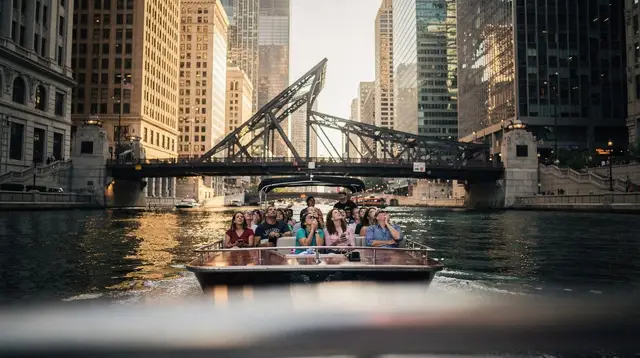
That version of the Riverwalk had a rough charm. It felt like a city trying something, not entirely sure it would work, and inviting you to watch it figure that out. I remember sitting on a floating dock near one of the mid-river coves on a weekday afternoon with almost nobody around, watching an architecture cruise boat go by, feeling like I had found an angle on downtown Chicago that most visitors missed entirely.
What it feels like now
The Riverwalk today is a finished product, and finished products behave differently than works in progress. The docks are full. The restaurants and bars that were meant to activate the space have mostly succeeded at that job, which means reservations, lines, and a level of ambient noise that the early Riverwalk never had.
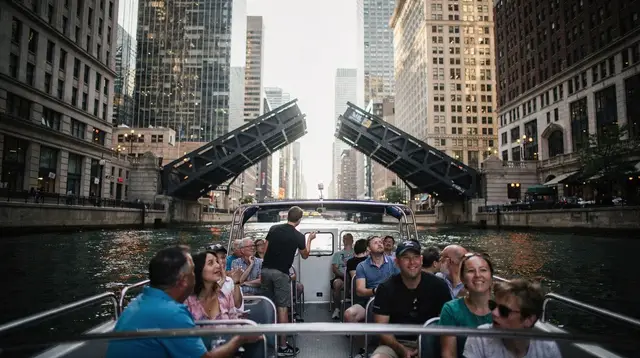
Architecture boat tours now depart in a near-constant rotation from multiple docks rather than the occasional single sailing, and if you’re weighing which operator or format to pick, our architecture river cruise guide and comparison of the main cruise companies both walk through the options that now leave from these docks. The kayak and paddleboard operators that once felt like an afterthought are now a fixture, with queues that back up onto the walkway on warm weekends; see our Chicago River kayaking guide if you’d rather be on the water than beside it, and our sunset kayak tour guide for the quieter evening version of that same crowd.
This is, by most planning metrics, a success story. A public space that draws people is doing what it was designed to do. But walking it now, a decade in, I noticed something the planning metrics don’t measure well: the Riverwalk has lost the sense that you might stumble onto it. It has become a destination in its own right, listed on itineraries, photographed from the same three angles by everyone with a phone, folded into the itinerary alongside Millennium Park and the Magnificent Mile rather than discovered as a detour from them.
There’s a particular stretch near the Loop, close to where the L rumbles overhead, where I used to like sitting with a coffee and watching the river traffic. That bench is still there. The view is the same. But the crowd around it now moves with a kind of choreography, phones out, waiting for the light to hit the water at the right angle, and I found myself moving through it rather than lingering in it, which is a different way of using a place.
The maturing of a designed space
Urban designers talk about the “life” of a public space as something that has to be earned continuously, not installed once. The Riverwalk was built with a clear intention: connect the disconnected south bank of the Chicago River, give the Loop a genuine waterfront, and create a car-free corridor that could host restaurants, boat launches, and pedestrian traffic in a city that had mostly turned its back on this stretch of river for a century. On those terms, it has matured well. The concrete has held up. The lighting still works. The docks haven’t fallen into disrepair, which is not nothing for a decade-old public works project in a city with a famously stretched maintenance budget.
What has changed is the texture of who uses it and why. In the early years, the Riverwalk drew a mix of curious locals testing out something new and a smaller number of visitors who had read about it in advance. Now it functions more like an extension of the tourist core that runs from the Art Institute of Chicago through Millennium Park to Navy Pier: a connective corridor that people move through as part of a checklist rather than a place they choose deliberately. The architecture cruise operators know this, and their schedules reflect it, running boats close to continuously through the warmer months rather than a handful of sailings a day.
I don’t think this is a decline, exactly. It’s what happens when a piece of infrastructure works as intended for long enough that its original audience gets replaced by whoever the infrastructure now attracts. The Riverwalk was built to be found. A decade on, it has been found, thoroughly, and the ease with which you can now find it is precisely what has made it harder to feel like you’re finding anything at all.
What’s actually different, concretely
A few things stood out on this most recent walk that weren’t there, or weren’t as prominent, a decade ago. The dining and drinking options have consolidated around a handful of well-known operators rather than the scrappier pop-ups of the early years. The water taxi stops feel like genuine transit infrastructure now, with real ridership, rather than a novelty for tourists. And the crowd itself has shifted seasonally in a way that tracks the city’s broader tourism calendar: packed on summer evenings and weekend afternoons, noticeably quieter on winter weekdays, when the wind off Lake Michigan makes the whole corridor feel exposed and half-abandoned again, briefly returning to something like its earlier character.
That winter version, oddly, is the one that reminds me most of the Riverwalk I first knew. Empty benches, a cold wind, and the same view of the Loop’s skyline that drew people here in the first place, before the crowds, the bars, and the constant boat traffic made it something closer to an outdoor mall with better views.
If you’re visiting now, none of this should keep you away. The Riverwalk remains one of the better free things to do along the water in the Loop, and the boat traffic it now supports, including a river architecture cruise that departs right from the Riverwalk docks, is genuinely worth the time even if it’s busier than it used to be. If you’d rather see the same skyscrapers on foot and at your own pace, a walking tour focused on the Loop’s Art Deco towers covers some of the same architectural ground without the dock lines, and our own Loop walking tour guide and architecture cruise versus walking tour comparison go into more detail on which format suits which kind of visitor. What’s worth knowing going in is that you’re visiting a mature, popular public space, not the quiet experiment it was a decade ago, and your expectations should be set accordingly.
Where the Riverwalk fits in a Chicago visit now
Ten years of maturing has also turned the Riverwalk into more of a connective piece of a larger downtown day than a standalone stop. It links, on foot, to the Chicago Riverwalk destination page and the broader Loop, and most first-time visitors now fold it into a single downtown day alongside the Willis Tower Skydeck and the Art Institute of Chicago. Our Chicago Riverwalk guide covers the practical layout of the docks and access points in more depth than this piece does, and our three-day first-timer itinerary and one-day architecture river cruise itinerary both show where a Riverwalk visit sits in a wider plan.
If you’re trying to time your visit to feel more like the Riverwalk of a decade ago, our best time to visit Chicago guide and Chicago winter activities guide both back up what I saw firsthand: winter weekdays are the closest thing left to the quiet original. In summer, expect the same crowd patterns as the Chicago lakefront generally, covered in our summer lakefront guide. And for getting to and from the Riverwalk itself, the Chicago Loop sits within easy reach of the Blue and Red Line “L” stops; our CTA “L” train guide and getting around Chicago without a car guide cover the transit side, since driving into the Loop for a Riverwalk walk is rarely worth it given downtown parking.
Riverwalk, then and now
| A decade ago | Now | |
|---|---|---|
| Crowds | Sparse, mostly locals | Heavy, especially summer evenings and weekends |
| Boat traffic | Occasional sailings | Near-continuous departures in warm months |
| Dining/bars | Sparse, some pop-ups | Established, often requiring reservations |
| Water taxis | Novelty | Functioning transit with real ridership |
| Best time to feel the old character | Any weekday | Winter weekdays only |
Questions about the Riverwalk’s evolution
Is the Chicago Riverwalk still worth visiting if it’s more crowded now?
Yes. It remains a free, walkable stretch along the Chicago River with genuine architectural views of the Loop, and the added dining and boat options mean there’s more to do than there was a decade ago. Just expect company, especially on summer evenings and weekends.
When is the Riverwalk least crowded?
Winter weekdays, when the wind off Lake Michigan keeps casual visitors away. Many riverside restaurants and some dock operations scale back or close seasonally, so check ahead if you’re visiting between December and February.
Has the Riverwalk changed physically since it opened, or just the crowds?
The physical infrastructure, the docks, paths, and lighting, has held up well and hasn’t changed dramatically. What’s changed most is usage: more restaurants and bars, more continuous boat departures, and a water taxi system with real commuter ridership rather than novelty traffic.
Are the architecture boat cruises still worth doing given how busy the docks are?
Most visitors still rate the cruises highly because the content, the Chicago School and later skyscrapers seen from the water, hasn’t changed. The difference now is booking ahead, since popular departure times sell out further in advance than they did a decade ago.
Is the Riverwalk connected to Millennium Park or Navy Pier?
It connects on foot to both. Walking east along the Riverwalk brings you toward the lake and Navy Pier; Millennium Park sits a short walk north of the Riverwalk’s western and central sections through the Loop.
Why does the Riverwalk feel more like a tourist corridor than a few years ago?
As the restaurants, boat tours, and water taxis matured into reliable, heavily used operations, the Riverwalk shifted from an experimental public space toward a fixture on standard downtown itineraries, alongside the Art Institute of Chicago and Michigan Avenue. That’s a natural outcome of a public space succeeding at its original goal.
Can you still find quiet spots along the Riverwalk?
Occasionally, particularly on weekday mornings before the lunch crowd or during the colder months. The floating docks and coves that once felt secluded are now more consistently occupied, but they’re not entirely gone.
tours.City life
Verified deep-linked GetYourGuide tours. Book through these links and we earn a small commission at no cost to you.
GetYourGuide does not provide a product photo for this activity — the image shows the meeting point, photographed by us.