Wheelchair access on the Chicago architecture river cruise
Is the Chicago architecture river cruise wheelchair accessible?
Most boats used for the Chicago architecture river cruise have step-free or ramped boarding and open deck space, but equipment varies by vessel and operator. Always confirm accessibility directly with the operator before booking rather than assuming it from marketing photos.
Why accessibility needs its own page here
The architecture river cruise is the single most booked activity covered by this site, and it is also one where a wheelchair user or anyone with limited mobility cannot simply trust a photo or a general description. For the general content on what the cruise covers, how long it runs, and which route it follows, see the architecture river cruise guide. This page stays narrowly on one question: can you get on the boat, stay comfortably for the length of the ride, and get off again, if you use a wheelchair or have limited mobility.
The honest answer is that it depends on the boat, the operator, and the day. Chicago’s architecture cruise business runs on several different vessels from several different companies, all launching from docks along the Chicago Riverwalk near the Loop. A boat that has a ramp and open deck space this season may be swapped out for maintenance, or a different boat may run your exact departure time. No single blanket statement holds for the whole industry, and this guide will not pretend otherwise.
What “accessible” actually means for this activity
Before booking, there are three things worth checking, and none of them can be assumed from a company’s website alone.
Step-free or ramped boarding. Some docks along the Riverwalk sit close to boat deck level and use a short ramp or gangway; others require a step down or up that varies with the river’s water level on the day. Water level on the Chicago River shifts with rain and lake conditions, which means the exact boarding gap can differ from one afternoon to the next even on the same dock.
A designated space on board, not just a seat near the front. An open area wide enough for a wheelchair, positioned so you are not blocking an aisle or exit route, is the standard to ask about. Fixed bench or theater-style seating without a cleared space is common on smaller boats and makes staying in your own chair difficult or impossible.
Trained staff able to assist with boarding. Even a boat with a ramp benefits from crew who have practiced guiding a wheelchair or scooter across it, especially when the river’s wake from passing boats makes the gangway move slightly. Ask whether crew have experience assisting wheelchair users, not only whether a ramp exists.
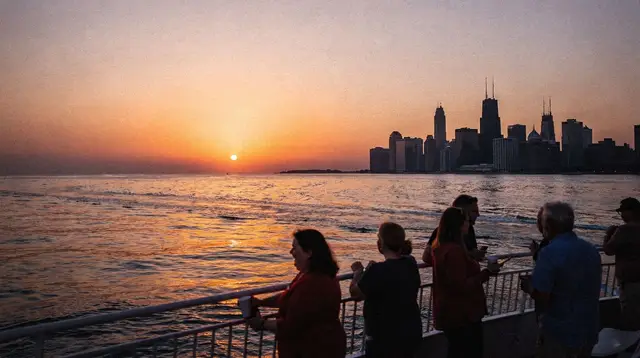
None of this is a reason to skip the cruise. It is the single most booked activity covered by this site precisely because the view from the Chicago River is unlike anything you get from the sidewalk — the same skyscrapers that define the Loop skyline look completely different from water level, low and close, with the boat passing directly under several bridges. The point of checking accessibility carefully beforehand is to make sure you get that view too, on equal footing, rather than discovering a problem at the dock.
Why the river itself complicates a simple yes-or-no answer
Chicago sits on a freshwater lake, not a tidal ocean, but the Chicago River still moves and its level still shifts, and that matters more for boarding than most first-time visitors expect. Rain upstream, lake seiches, and the operation of the lock system near the river’s mouth all nudge the water level up or down by a few inches over the course of a day. A dock that sits nearly flush with the boat deck in the morning can have a small step by the afternoon sailing, or the reverse. This is not something an operator hides from you; it is simply not fixed far enough in advance for a website to promise a specific boarding condition for a specific date months out. That is the entire reason this page pushes you toward a phone call rather than a page of marketing photos.
What to ask the operator before you book
Contact the operator directly, by phone rather than a general contact form, and be specific. A useful call covers:
- Which vessel is assigned to your date and departure time (schedules on the Riverwalk rotate boats through the day).
- Whether that vessel has step-free or ramped boarding at the dock you will use.
- Whether there is a cleared, designated space for a wheelchair on board, and where it sits relative to the best skyline views.
- Whether you can remain in your own chair for the ride, or whether transfer to a fixed seat is expected.
- The exact width, weight, and turning space needed if you use a power wheelchair or mobility scooter — give real dimensions rather than saying “powered chair.”
- Whether an accessible restroom exists on board, if that matters for your visit.
- How the crew handles boarding when the river’s water level or wake makes the gap uneven.
None of this should be treated as fixed once confirmed for a past booking. Vessels get reassigned, fleets change, and a company’s accessibility that worked for another traveler’s trip last year is not a guarantee for yours this month.
Timing your call
Contact the operator as early as you can once you have picked a date, and ideally at least a few days ahead. In the busy summer months, when demand on the Riverwalk is highest and boats run close to capacity, give a week or more so the company has time to check which vessel is scheduled and hold a space if needed. Calling the morning of your cruise leaves no room for the operator to switch boats or adjust timing if the assigned vessel does not suit your equipment.
If you are combining the cruise with a stop at the Chicago Architecture Center, mention that in the same call, since combo tickets sometimes tie you to a specific boat and dock.
Seasonal timing and weather to plan around
Chicago’s cruise season runs through the warmer months, and the practical weather at each end of it is worth building into your planning, not just the accessibility questions above. Early and late season sailings can mean a cold, windy afternoon on open water even when the sidewalk feels mild, since wind off the lake reaches the river corridor too; a wheelchair user waiting longer than a typical passenger to board or disembark feels that wind exposure more, not less. Mid-summer brings the opposite problem: warm, humid afternoons where a slow boarding process in direct sun is uncomfortable for anyone, and worth asking the operator about shade or a covered waiting area at the dock. Neither extreme should stop you from going, but it changes what to wear and how much buffer time to build into the day, especially if boarding takes longer than a standard sailing allows for.
Evening and sunset departures avoid the harshest midday sun and are worth asking about specifically if heat is a bigger concern for you than boarding logistics; see sunset river cruise and night architecture river cruise for how those later sailings differ from the standard daytime departure, since dock conditions and staffing can vary by time slot even on the same boat.
Comparing cruise formats for accessibility planning
The format of the cruise affects how much flexibility an operator has to accommodate you, independent of the specific boat’s equipment.
| Format | Typical group size | Accessibility planning flexibility |
|---|---|---|
| Large public daytime cruise | Often 100+ passengers | Fixed schedule, boarding must be quick; ask well ahead |
| Small-group or private cruise | Under 20, or just your group | Operator can plan boarding time and boat choice around you |
| Sunset or evening cruise | Public, moderate size | Same boarding constraints as daytime; lower light for photos |
| Combo ticket with a land visit | Public, fixed slot | Two accessibility checks needed, not one |
A private or small-group option gives the operator room to schedule boarding without a full public sailing waiting behind you, which matters most if boarding is slower with your equipment. See the general comparison in architecture cruise vs. walking tour if you are still deciding between a boat and a land-based option, and private architecture cruise for how a private booking works in practice.
Getting to and from the dock
The Riverwalk docks sit within walking distance of the Loop and are reachable without a car via the CTA or a taxi drop-off close to the water. If you are arriving directly from the airport, see the O’Hare transfer guide or the Midway transfer guide for step-free transport options into downtown, and getting around Chicago without a car for a broader look at accessible transit choices, including which CTA lines and stations have working elevators. If you are carrying luggage to or from the dock, the luggage storage guide covers nearby drop-off options so you are not managing bags and a wheelchair transfer at the same time.
Booking the cruise
Once you have confirmed accessibility details directly with an operator, several of the standard architecture cruise formats are bookable in advance. A shorter option, the 75-minute guided architecture cruise on the river, covers the core skyline route in a single sitting. Families or groups traveling with a wheelchair user alongside children sometimes prefer the family-friendly architecture river cruise, which runs at a more relaxed pace.
For a longer combination that pairs the cruise with the architecture center’s exhibits on land, the First Lady river cruise and architecture center combo ticket is worth checking, though it means confirming accessibility at two stops instead of one. A longer sailing, the 90-minute architecture boat tour on the river, covers more of the river’s north and south branches in a single trip if you would rather do one longer boarding process than split the route across two shorter cruises.
Whichever option you choose, treat the ticket purchase and the accessibility confirmation as two separate steps. Buying the ticket does not confirm the boat, the dock, or the crew’s ability to assist — that confirmation only comes from a direct conversation with the operator.
What your ticket confirmation email will and will not tell you
A booking confirmation typically lists your departure time, the general meeting point along the Riverwalk, and boarding instructions written for the average passenger. It will rarely name the specific vessel assigned to your sailing, because boat assignments are often finalized closer to the departure date based on maintenance schedules and demand. This is normal, not a sign that the operator is being evasive, but it does mean the confirmation email is not the place to look for an accessibility answer. Treat it as proof of your reservation and nothing more, and keep the phone conversation with the operator as your actual source for boarding details on the day.
If you booked through a third-party site rather than the operator directly, it is worth calling the operator’s own office as well, since the booking platform’s customer service line usually cannot answer vessel-specific questions and will simply relay you to the operator regardless.
What to bring and how to plan the rest of the day
A few practical steps make the boarding conversation easier on the day itself. Arrive at the dock earlier than the general boarding call, since a slower or assisted boarding process works better before a full queue has formed behind you. Bring a printed or saved note with your wheelchair or scooter’s exact width, length, and weight, so you are not trying to recall or estimate the numbers at the dock if a crew member asks. A light layer works for the breeze on open water even on a warm day, since the boat moves faster than a walk along the Riverwalk and the wind is more noticeable once you are underway.
Build slack into the rest of your day around the cruise rather than scheduling something immediately before or after it. Boarding and disembarking can simply take longer than a standard sailing’s turnaround allows for, and rushing that process works against you and the crew both. If you are pairing the cruise with a full day downtown, the 3-day Chicago itinerary and the wheelchair-accessible Chicago itinerary both build in that kind of buffer around water-based and walking activities.
Other accessible ways to take in the skyline
If a river cruise does not end up working for your dates or equipment, Chicago has more than one way to see its skyline, and it is worth knowing the options rather than treating the boat as the only path. The Willis Tower Skydeck, including its glass Ledge balconies, sits at 233 South Wacker Drive; see the Skydeck guide for what boarding and access look like there.
A separate belvedere, 360 Chicago with its TILT attraction, sits at 875 North Michigan Avenue in the former John Hancock Center — a different building and a different company from the Willis Tower, which is the single most common point of confusion for first-time visitors comparing the two. The TILT and 360 Chicago guide and the side-by-side Skydeck comparison lay out how the two towers differ. Neither is a substitute for the river-level view, but both offer a skyline perspective that does not depend on boat boarding logistics at all, and a helicopter tour is a further alternative for a very different vantage point over the same skyline.
If accessibility cannot be confirmed for your dates
Not every operator will be able to guarantee what you need for a given date or time. If that happens, ask about a different departure time the same day, a different vessel in the company’s fleet, or a different operator altogether — several companies run cruises from docks along the same stretch of Riverwalk, so a boat that does not work for one company’s schedule may be replaced by a better fit elsewhere. It is also worth checking the broader wheelchair-accessible Chicago tours guide for accessible alternatives to the river cruise, including land-based ways to see the same skyline, and the accessible Chicago itinerary for how to build a full day or trip around confirmed-accessible activities rather than assumptions.
The goal of this page is not to promise that the Chicago architecture river cruise works for every wheelchair user on every boat — it does not, and no honest guide can say that it does. The goal is to give you the exact questions to ask, and the exact lead time to ask them in, so the answer you get back is a real one from the operator running your boat, not a guess from a website.
Accessible tours in Chicago on GetYourGuide
Verified deep-linked GetYourGuide tours. Book through these links and we earn a small commission at no cost to you.
GetYourGuide does not provide a product photo for this activity — the image shows the meeting point, photographed by us.