Why Chicago sells its gangsters
A bar with a password and a wink
I found myself in a Fulton Market bar that made you knock and give a made-up password to get in, the walls hung with sepia photos of men in wide-lapel suits, a bartender reciting a line about “the old days” like he had said it a thousand times, which he probably had. It was well done. The cocktails were good, better than most of what you’ll find on a prohibition speakeasy bar tour. And I left feeling a low-grade discomfort I couldn’t quite place until I was walking back toward the Loop later that night, past a corner that thirty years ago was rail yards and stockyards, work that built the city in a much less photogenic way than a tommy gun.
That discomfort is what this piece is about. Not a takedown of anyone running a Prohibition-themed bar or a gangster bus tour, because the curiosity behind those things is real and I share a version of it. It’s a question about what a city chooses to put in the shop window when it tells its own story to strangers, and what gets left in the back room because it doesn’t sell as well.
The version of Chicago you meet first
Spend two days here as a first-time visitor and Al Capone will find you before Jane Addams does. He turns up on an architecture river cruise script, on a gangster bus tour, on the label of a beer, in the name of a bar. The Prohibition era gets its own category of tour operator, right down to a gangsters and ghosts walking tour. The Chicago Architecture Center will happily tell you about Sullivan’s ornament and Burnham’s plan along the Riverwalk, but ask a random tour guide what makes 1920s Chicago interesting and there’s a decent chance the answer starts with a nickname and ends with a body count.
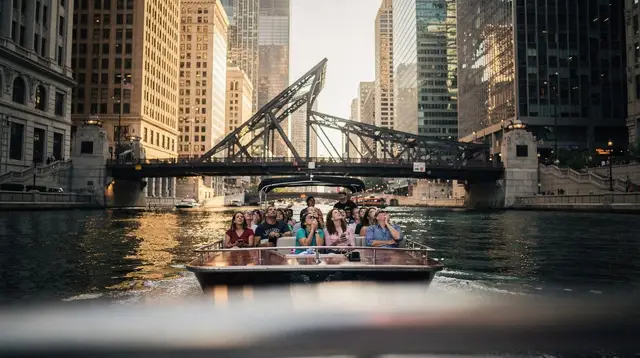
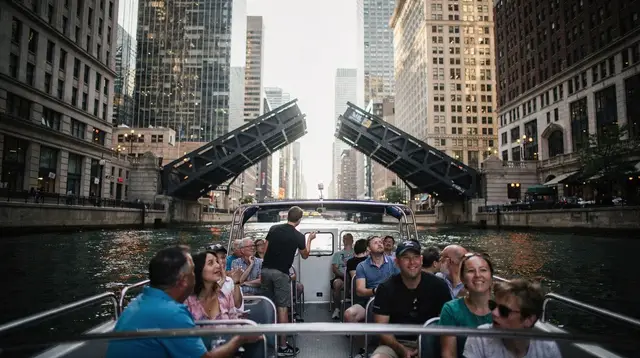
a sightseeing cruise past the same skyline that grew out of the fire and the Prohibition years alike spends more time on rivets and setbacks than on nicknames, which is part of why I’d put it ahead of the gangster bus on a first visit.
I don’t think this is an accident of tourism marketing so much as a consequence of what makes a good ninety-minute product. Al Capone has a face, a nickname, an ending. He fits a poster. The Grand Migration, the arrival of hundreds of thousands of Black Southerners into neighborhoods like Bronzeville, the invention of electric blues out of that upheaval, the meatpacking labor movements, the sheer engineering audacity of rebuilding a burned city into the birthplace of the skyscraper — these are bigger and more consequential stories, and none of them compress into a bar crawl with a costume.
What gets crowded out
The thing I keep circling back to is that Chicago’s actual history is not short on drama. The 1871 fire alone is a story of catastrophe and reinvention on a scale most cities never face, one that a good skyscrapers walking tour of the Loop actually gets into if you pick the right operator. The 1893 World’s Fair at Jackson Park pulled in more than 27 million visitors and reshaped how the world thought about American cities. The South Side’s role in Black American culture, from the Great Migration through the blues clubs that still operate today, is arguably more influential on the rest of the world than thirteen years of bootlegging ever was — you can hear it firsthand on a night out among the best blues and jazz clubs in Chicago.
None of that is hidden, exactly. You can find it at the Field Museum, in a genuinely good walking tour of Hyde Park near the university, or on a Pilsen mural and neighborhood tour a few miles away if you seek one out. But it isn’t what greets you at the airport gift shop or what a friend who’s never been here brings up when you say you’re going. The gangster narrative isn’t replacing the fuller history so much as it’s sitting in front of it, blocking the view for anyone who doesn’t go looking.
I think there’s something telling in which histories get turned into entertainment and which get turned into a museum wing you have to seek out. Violence committed mostly against other criminals, in a period now safely a century in the past, is easy to romanticize because nobody currently living has to reckon with it directly. The history of segregation, redlining, and labor exploitation on the South Side is harder to package as a fun night out because its consequences are still visible a few blocks from where you’re standing, in disinvestment that never fully reversed. A city, like a person, tends to tell the story that’s flattering or at least thrilling before it tells the one that implicates it.
Not an argument against curiosity
I want to be careful here, because I don’t think wanting to see a bullet-scarred old brick wall or hear about a devil-in-the-white-city bus tour makes anyone a ghoul. History that includes violence and vice is still history, and pretending Prohibition-era Chicago didn’t happen would be its own kind of dishonesty. My problem isn’t with the existence of a gangster tour. It’s with a tourism ecosystem where that tour is often the loudest, most visible thing on offer, while a walking tour through Hyde Park or Bronzeville takes real effort to find, and gets a fraction of the marketing budget.
What would change my mind about the balance isn’t fewer speakeasy bars. It’s more visible, better-funded, equally well-produced options for the other stories — the architecture that came out of the fire, best seen on an art deco skyscrapers walking tour, the music that came out of the Migration, the industrial history that came out of the stockyards. Some of that exists here already, quietly, done well by people who care about it. It just isn’t first in line.
A walk focused purely on the city’s art deco skyscrapers is a good example of the kind of tour that deserves more of the spotlight the gangster circuit currently holds.
What I’d tell someone planning a trip
If you’re drawn to the Capone era, go ahead and take that tour — I did, and parts of it were genuinely well researched. Just don’t let it be the only lens you look through. Spend an afternoon in Bronzeville. Sit through a set at a blues club that’s been open since the 1950s. Walk through the Museum Campus and think about what it took to stage a fair that pulled in a quarter of the world’s population that visited a fair anywhere that decade. Chicago will hand you the gangster story without you asking for it. The rest, you’ll have to ask for.
FAQ about Chicago’s gangster-era tourism
Is the Al Capone tourism industry in Chicago historically accurate?
Much of it is loosely accurate on names, dates, and locations, but tends toward dramatization and legend where the historical record is thin. Treat it as entertainment with a factual skeleton rather than a rigorous history lesson.
Are there Prohibition-era sites you can still visit in Chicago?
Some buildings and bars trade on real Prohibition-era connections, others are themed reconstructions with no direct historical link. It’s worth asking a guide or operator directly which category a given stop falls into.
Why does Chicago’s tourism marketing focus so much on the 1920s over other eras?
The era offers a clear narrative, a recognizable villain, and imagery that packages easily into short tours and branded bars, which makes it commercially convenient compared to more complex histories like migration or labor movements.
Where can I learn about Chicago’s Great Migration and blues history instead?
Bronzeville on the South Side and its historical markers, along with the city’s remaining blues clubs, are the most direct starting points, alongside museum exhibits that cover the period in more depth than a walking tour typically allows.
Is it disrespectful to take a gangster-themed tour in Chicago?
Not inherently — the interest is understandable and the era is part of the historical record. The concern raised here is about balance in what the city promotes overall, not about individual visitors’ curiosity.
What happened at the 1893 World’s Fair in Chicago?
The World’s Columbian Exposition was held at Jackson Park on the South Side and drew more than 27 million visitors, leaving a lasting mark on American architecture and urban planning.
Does the South Side deserve its reputation as separate from downtown Chicago’s tourist image?
The South Side’s reputation is shaped by a mix of real disinvestment and outdated stereotyping; neighborhoods like Hyde Park and Bronzeville hold significant cultural and historical sites that don’t fit the area’s popular caricature.
tours.History
Verified deep-linked GetYourGuide tours. Book through these links and we earn a small commission at no cost to you.
GetYourGuide does not provide a product photo for this activity — the image shows the meeting point, photographed by us.