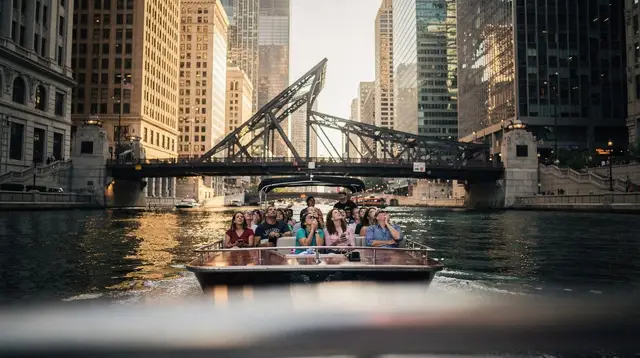
Prohibition speakeasy bar tour guide, Chicago
What is a Prohibition speakeasy bar tour in Chicago?
It's an evening, 21-and-over experience that moves between bars styled after 1920s speakeasies, often with a hidden or unmarked entrance, period cocktails, and a guide narrating Prohibition-era history along the way. It's built around the atmosphere and the drinking, not a daytime walk past historic addresses.
A night out built around the Prohibition years, not a history lecture
Chicago sells its 1920s past in two very different formats, and mixing them up is the easiest way to book the wrong evening. One is the daytime, narrative-driven gangster tour: a bus or walking route past real addresses tied to Al Capone, bootlegging, and the violence of the era, aimed at anyone curious about the history regardless of age. The other is what this guide covers: an evening, 21-and-over experience where the point is to sit or stand inside bars styled after speakeasies, drink period-inspired cocktails, and let a guide fill in the historical backdrop between stops. Think of it as a themed night out that happens to be educational, rather than a history tour that happens to serve drinks.
This matters for planning because the two products have almost nothing in common beyond the decade. A gangster tour works for families and can run any time of day. A speakeasy bar tour is an adults’ evening activity, it runs after dark, and it assumes you’re there to drink. If you want both angles, treat them as separate bookings rather than one combined outing — most operators sell them that way too.
The city’s actual Prohibition history gives the format its texture. Alcohol was federally banned nationwide from 1920 to 1933, and Chicago’s response was famously loud: illegal breweries and distilleries, a network of hidden bars, and organized crime figures — Al Capone chief among them — who built fortunes supplying the demand. Almost none of the original speakeasies survived Prohibition’s repeal intact, so the bars you’ll visit tonight are modern establishments deliberately designed to evoke that period, not preserved relics of it.
Age requirement — this is a hard line, not a suggestion
Every stop on a speakeasy bar tour serves alcohol, which means every participant needs to be 21 or older and carry valid, government-issued photo ID (a driver’s license or passport, not a photo of one). Operators and the bars themselves are legally required to check, and it isn’t a formality — expect ID checks at more than one venue over the course of the evening, especially at anywhere with a hidden or restricted entrance. If your group includes anyone under 21, this is not the tour: look instead at a daytime option like the Al Capone gangster tour or the Devil in the White City bus tour, neither of which involves alcohol service.
What the atmosphere is actually going for
The visual language of a modern Chicago speakeasy borrows a specific set of cues from the 1920s, and recognizing them helps set expectations before you book:
- A concealed or unmarked entrance. Some bars hide behind an unlabeled door, a phone booth, a bookshelf, or a storefront that reads as something else entirely (a diner, a laundromat, a barber shop). It’s theater, not real secrecy — most are easy to find with a quick search — but the reveal is part of the appeal.
- Low light and close quarters. Dim lighting, dark wood, leather booths, and a deliberately intimate room size, in contrast to the open, brightly lit sports bars common elsewhere downtown.
- Cocktails built around the era, not around it. Classic Prohibition-adjacent drinks — sidecars, gin rickeys, Sazeracs, Old Fashioneds — served with the kind of attention to technique that the craft cocktail movement has brought back over the last two decades.
- Period dress, staff, or live music, at some venues. A handful lean further into the theme with 1920s-inspired staff uniforms, jazz or ragtime sets, or scheduled “raids” as a playful bit of theater. Not every stop will do this; it varies a lot by venue.
- No fixed pricing promised here. What a given night costs depends entirely on the operator, the number of stops, whether drinks are included, and the specific bars on the route — check the current listing for exact inclusions before booking.
Speakeasy bar tour or craft cocktail tour — pick the right one
If what actually interests you is the drink itself — the technique, the ingredient sourcing, the bartender’s craft — rather than the Prohibition backstory, a contemporary tour is the better fit. Chicago’s cocktail scene today draws on the same classic techniques but doesn’t necessarily wrap itself in 1920s theming, hidden doors, or gangster-era narration. The craft cocktail bars guide covers that scene on its own terms, without assuming you want a history lesson between rounds. A useful way to decide: if you’d be disappointed by a bar with normal signage and modern décor, go with the cocktail-focused route instead.
Format: walking, bus, or a mix
Prohibition speakeasy experiences run in a few different shapes, and the fit depends on how much walking you want to do on a night out:
| Format | Typical stops | Walking | Best for |
|---|---|---|---|
| Walking tour | 2 to 4 bars | Moderate, mostly flat downtown or Near North blocks | Groups happy to be on their feet between drinks |
| Bus or trolley tour | 2 to 4 bars, spread further apart | Minimal | Larger groups, colder months, less mobile guests |
| Small-group or private route | Customizable | Varies | Bachelor/bachelorette parties, birthdays, corporate nights out |
A combined bus-or-walking option exists specifically because operators know both crowds show up for this theme — check the listing to see which format a given date offers before booking, since not every departure runs both ways.
this Prohibition speakeasy tour, offered as either a bus or walking route through Chicago’s hidden bars is the most direct match for the theme covered here, and it’s worth checking which format is running on your date before you commit.
Fact versus theater: what’s real and what’s staged
Part of the fun of this format is not always knowing where the history stops and the performance begins, but it’s worth being honest with yourself about it going in. The concealed doors are a design choice made decades after repeal, not a surviving wartime precaution. The “raids” some bars stage are scripted entertainment, not a reenactment of an actual event at that address. Guides on these tours will usually flag what’s documented history and what’s atmosphere, but if you want a tour built specifically around separating the two, a myth-versus-reality walking tour does that more explicitly and runs earlier in the day.
a walking tour that separates documented Prohibition history from the legends that have grown around it pairs well as a daytime companion if you want the factual grounding before the evening’s theatrics.
Where these tours tend to run
Chicago’s Prohibition-era geography clusters heavily around the Loop, River North, and the Old Town and Lincoln Park area, where several bars with hidden-entrance concepts and 1920s theming have opened over the past decade. Old Town in particular carries a strong Prohibition association thanks to its history as a nightlife district going back to that period, and a dedicated Old Town and Lincoln Park walking tour covers the neighborhood’s broader story if you want context beyond the bar stops themselves. Exact venues and routes vary by operator and change over time as bars open and close, so treat any specific address as current only at the time you book rather than a fixed fact about the city.
Pairing a speakeasy bar tour with the rest of your night
Because this is an evening activity, it pairs naturally with other after-dark options rather than daytime sightseeing. A few combinations that make sense:
- With live music. Chicago’s blues and jazz scene has real historical ties to the same decades — the best blues and jazz clubs guide is worth a look if you want to extend the era-appropriate soundtrack after the bar stops wrap up.
- With a themed crime tour earlier in the night. For a fuller Prohibition arc in one evening, some visitors do the an after-dark crime-themed tour through the city’s most notorious locations before heading into the bar-hopping portion, though check timing carefully since both run in the evening and can be tight to fit back to back.
- With dinner beforehand. Since the bar stops are the main event, eating first is worth planning for — a downtown food tour built around Chicago’s pizza styles is one straightforward way to line up dinner before the theme shifts to cocktails.
- As part of a broader themed evening. For a structured night that already blends dinner or a show with the gangster-era narrative, see the dinner and a show guide.
- As a full itinerary. If you’re building more than one evening around this theme, the gangsters and Prohibition itinerary and the blues and jazz nights itinerary both sketch out multi-stop evenings that a speakeasy bar tour slots into.
What it doesn’t cover
A speakeasy bar tour is not a substitute for the ghost-tour side of Chicago’s dark history, which leans on hauntings and unexplained events rather than Prohibition-specific crime and drinking culture — see the ghost tours guide or Old Town’s haunted history for that angle instead. It’s also not a deep dive into Al Capone’s specific crimes and the buildings tied to them; that’s squarely the gangster tour guide’s territory, or the more theatrical gangsters and ghosts walking tour if you want both threads combined into one outing. And it’s worth repeating: it’s not a cocktail-craft masterclass — for that, the craft cocktail bars guide is the better starting point.
For a wider sense of why this era still sells so well as entertainment in Chicago decades later, the blog piece on the city’s gangster branding is worth a read alongside any tour you book — it’s a useful gut check on how much of the appeal is documented fact versus a very durable marketing story. You can also browse the full gangster and Prohibition tour category for the range of daytime and nighttime options built around this same slice of the city’s history.
What the night actually costs, beyond the tour ticket
The tour price rarely covers everything you’ll spend. Illinois and Chicago layer on a combined sales tax of roughly 10.25% in 2026, which applies to any drinks or food purchased separately at a venue — worth factoring in if an operator advertises a base price with drinks billed à la carte at each stop. Tipping bartenders is a separate line again: figure on the usual 18% to 22% range you’d leave at any Chicago bar or restaurant, per round or per tab depending on how a venue runs its service. None of this is unique to a speakeasy tour, but the multi-stop format means it adds up faster than a single night out at one bar, since you’re tipping and potentially buying drinks at each of two to four venues rather than settling one tab.
If the evening is part of a longer trip that includes a hotel stay, know that Chicago’s lodging taxes are separately, and notably, high — on the order of 17% to 19% depending on the property’s location, though the exact rate has been revisited in 2026 and is worth confirming against your specific reservation rather than assuming last year’s figure. That’s a hotel-stay cost, not a bar-tour cost, but it’s part of the same evening’s total if you’re visiting specifically for this kind of night out.
Getting to the meeting point and home afterward
Most speakeasy bar tours start and end somewhere downtown or in River North, both well served by the CTA’s elevated “L” train — but not every line runs all night. Only the Red Line and the Blue Line operate 24 hours a day; every other route, including the Brown, Green, Orange, Pink, and Purple Lines, stops overnight, so a tour that wraps up late is a different logistics problem depending on which neighborhood you end up in. Loading a Ventra card before you go covers both the L and Chicago’s bus network, and it’s worth having one regardless of which line you end up needing. For a fuller rundown of how the system fits together, the CTA “L” train guide and the broader getting around Chicago without a car guide both cover the network in more depth than a single tour night requires.
If you’re flying in specifically for a themed evening like this, it’s worth knowing the two airports sit on opposite sides of the city and serve different L lines: O’Hare connects via the Blue Line, roughly 40 to 45 minutes from the Loop, while Midway connects via the Orange Line, roughly 25 to 30 minutes — neither runs on the overnight schedule the Red and Blue Lines get downtown, so factor that into an early-morning departure the day after a late bar-hopping night. A rideshare or taxi is the simpler call once the L stops running for the night, regardless of which airport you’re headed to.
Booking notes
Availability for evening bar-hopping tours tends to be tighter on Friday and Saturday nights, and popular routes can sell out a week or more ahead during summer and the December holiday season. Because pricing and included drinks vary by operator and change over time, always confirm the specific inclusions — welcome cocktail, tastings, or drinks purchased separately at each stop — on the current listing rather than assuming based on a past visit or another city’s version of the same concept. And regardless of format, plan for a cab, rideshare, or the CTA’s late-running Red or Blue Line to get home, since drinking is the point of the evening, not an afterthought.
Al Capone and Prohibition-era gangster tours of Chicago on GetYourGuide
Verified deep-linked GetYourGuide tours. Book through these links and we earn a small commission at no cost to you.
GetYourGuide does not provide a product photo for this activity — the image shows the meeting point, photographed by us.