Al Capone and gangster tours in Chicago: a practical guide
What does an Al Capone gangster tour in Chicago actually cover?
It's usually a guided walk or bus route through downtown and nearby neighborhoods, narrating Prohibition-era organized crime, Al Capone's rise, and the era's most documented events. Tours describe sites associated with that history rather than claiming exact, unverified addresses for every stop.
Why Al Capone tours exist in Chicago
Chicago sells its gangster history hard, and the demand is real. Travelers researching organized crime in the United States, Prohibition, or the 1920s inevitably land on Al Capone, and Chicago is where that story is most concentrated: bootlegging, rival gangs, the Saint Valentine’s Day Massacre, and a police and political system that struggled to contain any of it. A steady stream of operators, from small walking-tour companies to larger bus operators, have built products around this specific pocket of history.
This guide is about that specific format — tours built around Al Capone and Prohibition-era organized crime as history, for travelers who want the documented story rather than a bar crawl or a ghost hunt. It’s a different audience from the Prohibition speakeasy bar tour guide, Chicago crowd, who want drinks and atmosphere more than dates and facts, and different again from the Haunted history tours of Old Town, Chicago crowd, who are there for the supernatural angle. If you want the history without either of those detours, this is the category to book from.
What a gangster and Al Capone tour actually looks like
Most tours in this category run one of two formats: a guided walk through downtown Chicago, or a narrated bus route that covers more ground. Both formats cover broadly the same material — Prohibition, the rise of organized crime in the 1920s, Al Capone’s operations, and the Loop and near-north neighborhoods where much of that history is set. What differs is pace, distance, and how much a guide can dig into a single location versus keeping a route moving.
| Format | Typical length | Typical distance | Best for |
|---|---|---|---|
| Walking tour | 90 minutes to 2 hours | 1 to 2 km | Travelers who want detail and can walk that distance |
| Bus tour | 2.5 to 3.5 hours | Wider downtown + nearby areas | Travelers with mobility limits, or who want more ground covered |
| Food-and-history combo | 2 to 3 hours | Varies by neighborhood | Travelers who want food stops built into the history walk |
A guided walk through the Loop and Old Town area is the most common version, and it pairs naturally with the neighborhood’s other historic character — see the Lincoln Park and Old Town: a daytime walking guide for context on that district beyond the gangster angle.
One combination worth knowing about: a food-focused gangster tour, which pairs the historical narration with stops for local food along the route. It’s a middle ground between a straight history walk and a full Chicago food tours: how to choose the right one experience. For that format, look at Chicago’s Gangster Food Tour, which combines Prohibition-era narration with food stops rather than treating history and eating as separate outings.
What’s covered — and what’s honestly uncertain
A responsible tour, and a responsible guide book, separates documented history from folklore. Here’s roughly how that line falls in Chicago’s gangster tourism:
Well documented, safe to expect on a tour:
- The broad arc of Prohibition (1920–1933) and why it created the conditions for organized crime to flourish in Chicago
- Al Capone’s rise as head of the Chicago Outfit and his eventual 1931 conviction on tax evasion, not on violent crime charges
- The Saint Valentine’s Day Massacre of February 1929, its rough location, and its role in turning public opinion against organized crime
- The role of corrupt police and city politics in enabling bootlegging through the 1920s
- The general geography of where speakeasies, breweries, and gang territory clustered downtown and on the near north and south sides
Frequently claimed, but worth treating with skepticism:
- Exact addresses presented as “Capone’s real hideout” — many of these buildings have been demolished, rebuilt, or renumbered, and claims vary between operators
- Specific dialogue or day-by-day accounts of events with no surviving documentation
- Claims that a specific surviving building interior was used by Capone’s operation, without a cited source
A tour operator who says “this block was part of Capone’s territory” is on solid ground. One who says “Capone stood exactly here on this date and said this” should be taken with real caution — that’s storytelling dressed as history, and it’s common in this category because the story sells better than the caveats. This guide’s position: enjoy the storytelling as entertainment, but don’t repeat unverified specifics as fact afterward.
How this differs from the two tours it gets confused with
Two other products in Chicago’s tour market get lumped in with “gangster tours” and shouldn’t be.
The bus tour built around the 1893 World’s Fair and H.H. Holmes. That’s a separate, specific product covered in The Devil in the White City bus tour: a practical guide. It’s set thirty years before Prohibition and centers on a different kind of crime story — a serial killer operating around the World’s Columbian Exposition, not organized crime and bootlegging. If you booked expecting Al Capone content and got the Devil in the White City tour, you’d be disappointed; the eras and subjects don’t overlap much beyond both being “true crime in old Chicago.”
The speakeasy bar tour. Covered in Prohibition speakeasy bar tour guide, Chicago, this is built around visiting bars with a speakeasy theme, often with drinks included, and it leans toward a fun night out rather than a history lecture. Some patter about Prohibition is part of the experience, but the point of the evening is the bars, not the history. If your priority is learning the documented history, a straight walking or bus gangster tour serves that better; if your priority is a themed bar crawl, the speakeasy tour is the one to book.
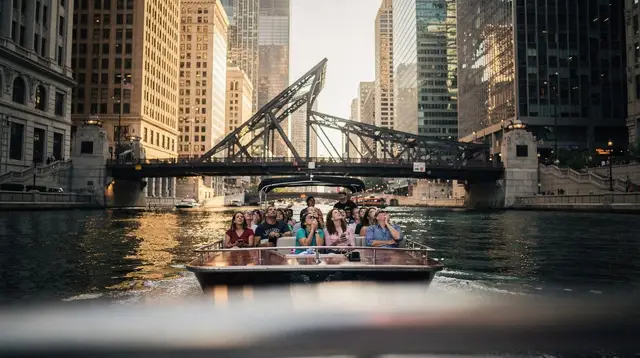
There’s also a hybrid worth flagging for travelers who genuinely want both angles: Gangsters and ghosts walking tour: is the combined format worth it? blends organized-crime history with local ghost lore in one route. It’s a legitimate third option, distinct from a pure history tour and from a pure Ghost tours in Chicago: a guide to the city’s haunted side experience — worth choosing deliberately rather than by accident. One version of that hybrid runs after dark and adds a physical element: Chicago’s Ghosts and Gangsters Night Kayak Tour covers the same crime-and-lore narration from the Chicago River rather than on foot.
Choosing between a walking tour and a bus tour
If you’re deciding between formats, a few practical questions settle it:
- Can you comfortably walk 1 to 2 km over uneven downtown sidewalks? If not, a bus tour removes that constraint.
- Do you want to cover more ground, including sites outside the immediate Loop? A bus route generally reaches further in the same time window.
- Do you want more time and detail on fewer stops? Walking tours tend to let a guide dwell longer on each location.
- Is a full-day city overview more useful to you than a niche gangster focus? If you’d rather fold the gangster narration into a broader city tour, Chicago’s Full Day Guided City Tour by Bus covers general sightseeing with historical narration woven in, rather than a tour built exclusively around organized crime.
A dedicated walking option that stays close to the documented history and skips the ghost material is Chicago’s Gangsters and Ghosts 2 Hour Walking Tour — despite the name pairing both themes, check the operator’s current route description, since some editions of this style of tour lean more history-heavy than others.
A cemetery angle worth knowing about
Several figures connected to 1920s Chicago crime, along with architects, business figures, and other notable Chicagoans, are buried at Graceland Cemetery on the North Side. It’s a different kind of stop from a downtown walking route — quieter, more reflective, and focused on funerary architecture as much as any single biography. For travelers who want to extend the historical thread into a cemetery visit rather than stick to street-level narration, Chicago’s Graceland Cemetery Guided Walking Tour is the relevant option, and it pairs reasonably well with a morning gangster walk if you’re building a themed half-day.
Booking practicalities
Prices for this category generally run in the range of moderate walking-tour pricing for a small-group guided walk, up to higher pricing for a multi-hour bus route with a larger vehicle and more ground covered — always confirm the current price and any age restrictions on the operator’s own listing before booking, since these change by season and by group size. Most walking tours meet at a fixed downtown point and don’t include transportation to that meeting point; bus tours typically include a pickup or a fixed downtown departure point, so check which applies before you plan your morning.
Group size varies by operator: small-group walking tours tend to cap attendance for audibility on busy downtown sidewalks, while bus tours can run larger. If you’re sensitive to group size, ask before booking rather than assuming.
Weather matters more for walking tours than bus tours, given Chicago’s wind and its cold winters (see the Best time to visit Chicago guide for seasonal context) — a bus format is the more comfortable choice if you’re visiting in deep winter and still want this content.
Building it into a longer visit
A gangster or Al Capone tour slots naturally into a broader downtown day. Many travelers pair it with a walk through the Loop itself, a stop at one of the city’s Chicago blues and jazz clubs: a practical guide in the evening (the genre’s Chicago lineage runs through the same decades), or a full themed day built around Prohibition and organized crime — see the 2 days of gangsters and Prohibition in Chicago itinerary for a structured version of that day. For more on why this particular slice of history sells so consistently to visitors, the Why Chicago sells its gangsters piece is worth reading before or after your tour. And for the full landscape of what’s available in this niche, the Al Capone and Prohibition tours category page lists the current operators and formats side by side.
Frequently asked questions about Al Capone and gangster tours in Chicago
Is this the same as a Chicago ghost tour?
No. Gangster and Prohibition tours focus on documented organized-crime history, not hauntings. Chicago also runs dedicated ghost tours, and a handful of hybrid tours mix both themes for travelers who want either angle.
How is this different from the Devil in the White City bus tour?
That tour is built specifically around the 1893 World’s Fair and H.H. Holmes, run as a narrated bus route. Al Capone and gangster-focused tours instead center on 1920s organized crime and Prohibition-era Chicago, and most run on foot rather than by bus.
Is this the same as the speakeasy bar tour?
No. The Prohibition speakeasy tour is built around visiting bars with a speakeasy theme and trying drinks. A gangster tour is a walking or bus history tour narrating events and locations; it does not usually include bar stops or drinks in the ticket price.
Are the exact addresses of Al Capone’s hideouts shown on the tour?
Be cautious of any tour that claims certainty here. Many popular addresses tied to Capone are disputed, demolished, or rebuilt, and guides differ on details. Reputable tours describe the history and general locations rather than asserting an unverified exact address as fact.
How long does a gangster walking tour take?
Most run about 90 minutes to 2 hours, covering roughly 1 to 2 kilometers on foot through downtown or a nearby historic district, depending on the operator.
Is this tour appropriate for kids?
It depends on the operator. Content covers real violence and organized crime, described historically rather than graphically on most routes, but check the specific tour’s age guidance before booking for younger children.
Does the tour go inside any historic sites?
Most gangster walking tours are outdoor, narrated routes past buildings and streets, not indoor visits. If a tour promises indoor access to a specific historic interior, verify that claim with the operator before booking.
What’s the hybrid option that combines gangsters and ghosts?
A small number of tours pair Prohibition-era crime history with local ghost lore in a single route. That’s a different product from a straight history tour, aimed at travelers who want both angles rather than one or the other.
Al Capone and Prohibition-era gangster tours of Chicago on GetYourGuide
Verified deep-linked GetYourGuide tours. Book through these links and we earn a small commission at no cost to you.
GetYourGuide does not provide a product photo for this activity — the image shows the meeting point, photographed by us.