The Bean and the selfie crowd
I got to Millennium Park a little after eleven on a Saturday in July, which in retrospect was exactly the wrong idea. I’d seen photos of Cloud Gate for years before I ever stood in front of it, and I wanted, in some vague way, to actually look at it. What I got instead was a slow shuffle through a ring of people three or four deep, most of them holding phones up at arm’s length, angling for a reflection of themselves warped across the surface of a ninety-nine-ton sculpture of polished stainless steel.
I want to be fair to the place before I say anything critical. Cloud Gate is a genuinely well-made object. Anish Kapoor’s design distorts the Loop skyline and the crowd itself across a seamless, mirror-like skin, and there’s a real pleasure in walking underneath it and watching the reflections fold in on each other. It’s free, it sits in the middle of a park that costs nothing to enter, and it has become, fairly or not, the single image most people conjure when they think of Chicago. None of that is in dispute.
What surprised me was how hard it was to simply stand still and look at it. Every few seconds someone stepped into my sightline to pose, phone extended, waiting for a gap in the foot traffic that never really opened. Groups arranged themselves in loose formations, checked the screen, rearranged, checked again. A few people didn’t seem to look at the sculpture directly at all — they looked at the phone, framed the shot, and moved on to the next spot in the park without, as far as I could tell, ever actually seeing the thing they’d traveled to see. I don’t say that with much superiority, because I was doing a version of the same thing, trying to find an angle without a stranger’s raised arm in it.
It raised a question I couldn’t quite shake for the rest of the day: at what point does a landmark stop being a place you visit and become a backdrop you extract from? I don’t think this is unique to Chicago, and I don’t think it’s unique to Cloud Gate. Any object that photographs well and sits in a free, accessible, heavily trafficked park in the Loop is going to end up serving double duty as a stage set. But standing in that ring of raised phones, the distinction felt unusually literal. The sculpture reflects everyone looking at it, which means the crowd photographing itself is, quite mechanically, part of the image everyone is trying to capture. It’s almost too neat a metaphor for what’s happening.
I left irritated, honestly. Not at any individual person — nobody there was doing anything wrong, and plenty of them were clearly delighted, kids especially, running back and forth to watch their reflections stretch and shrink. My irritation was more with the shape of the whole scene: an artwork built to reward slow, curious looking, absorbed instead into a fast loop of pose, check, move on. It felt less like people encountering Cloud Gate and more like people confirming they had been in its presence, which is a different activity entirely.
A few weeks later I went back, mostly by accident. I was in the Loop early for an unrelated reason, before seven, and Millennium Park was close by. The difference was total. There were maybe a dozen people scattered across the whole plaza — a jogger cutting through, someone walking a dog, one other person with a proper camera on a tripod who nodded at me and went back to waiting for better light. I stood under the sculpture for probably ten minutes without anyone else stepping into the space. The skyline reflected in that early, flatter light looked different than I remembered from the postcards — softer, less saturated, more like an actual morning than an advertisement for one. I could hear the fountains in the park and very little else.
I don’t want to turn that morning into a tip, a secret hour to recommend, because that would just be swapping one kind of ritual for another — the quiet version instead of the crowded one, still organized around getting something out of the place rather than being in it. What struck me wasn’t that early morning is “better,” in some objectively measurable sense. It was that the object itself hadn’t changed at all between my two visits — same steel, same park, same skyline — and yet my experience of it was almost unrecognizable. The crowd wasn’t incidental to what Cloud Gate had become for me. It was, on that first visit, most of what I was experiencing, and I’d mistaken my frustration with the crowd for a judgment about the artwork.
That distinction has stuck with me since, and it’s changed how I look at a few other spots in the Loop that get the same treatment — a particular sightline down the river, a corner near the Art Institute where the light hits the facade a certain way in late afternoon, a stretch of the Riverwalk where everyone seems to stop for the same photo. None of these places are lesser for being popular, and I’m wary of the reflex that treats crowds as proof that something has been ruined. But I’ve started to notice the moment when I’m not really looking at a place anymore, just gathering evidence that I was there. It’s a subtle line, and I don’t think I always land on the right side of it.
What I keep coming back to is that Cloud Gate didn’t ask to become a decision point for how people relate to landmarks. It’s a sculpture in a park. The selfie choreography around it says less about the artwork than about a particular way of moving through a city — quickly, acquisitively, camera-first — that has become close to default in places built for it. Seeing that pattern clearly, for me, took standing in the middle of it on a crowded Saturday and then, almost by chance, watching it disappear on a quiet weekday morning. I’m not sure which version is the “real” Cloud Gate. I suspect they both are, and that says something worth sitting with about how we visit things now, whether or not we ever put the phone down.
Cloud Gate and the crowd: questions worth asking yourself
Is Cloud Gate (“the Bean”) worth seeing given the crowds?
Yes, but midday and weekend visits mean shuffling through a dense ring of people taking photos, which changes the experience. Early morning, before most of downtown Chicago is awake, the same free sculpture in Millennium Park is a completely different, quieter encounter.
Is Cloud Gate free to visit?
Yes. Cloud Gate, in Millennium Park in the Loop, has no admission and no ticket booth. You can walk up to it and under it at any hour the park is open.
When is Millennium Park least crowded?
Early morning, well before nine, tends to be quieter, along with weekday mornings outside of summer conference season. This isn’t a scheduling tip so much as an observation about when the ritual around the sculpture changes shape.
Why do people call it “the Bean” instead of Cloud Gate?
Cloud Gate is the sculpture’s official title, by artist Anish Kapoor, but its bean-like shape gave it the nickname almost immediately after it opened in 2006, and the nickname stuck harder than the name.
Is it normal to feel underwhelmed by famous landmarks like this?
It’s a common enough reaction that it’s worth taking seriously rather than dismissing as jadedness. A landmark saturated with photography can start to feel like a stage set rather than a place, regardless of how striking the object itself is.
Are other spots in the Loop affected by the same crowding pattern?
Some of the more photogenic corners of the Loop and the Chicago Riverwalk see similar clusters of people angling for the same shot, though none quite as concentrated as the reflective surface of Cloud Gate.
Does visiting early mean missing anything?
You won’t get the same street energy or the crowd itself, which is its own kind of urban spectacle. What you get instead is the sculpture and the skyline it reflects, largely uninterrupted.
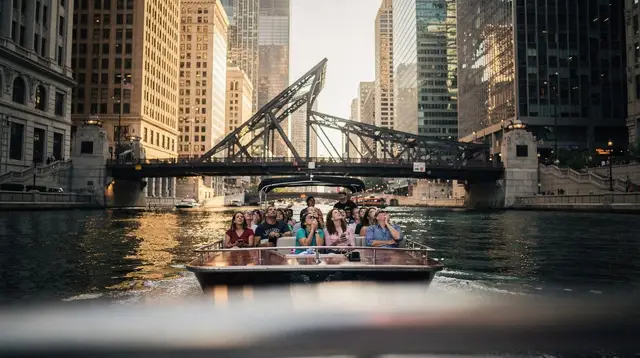
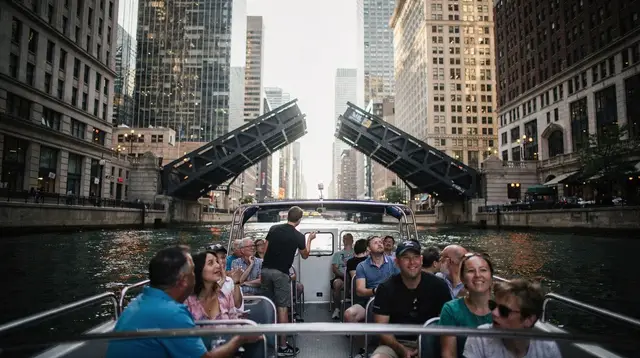
If you want the wider context for the neighborhood around the sculpture, there’s more on the Loop and on Chicago as a whole. For a sense of how a river-level view compares to a park-level one, I’d point to a Chicago: Architecture Boat Tour or read up on the architecture river cruise guide before deciding which angle on the skyline suits you. Walking tours through classic Loop skyscrapers or the more design-focused art deco walking tour — bookable as an Art Deco Madness walking tour through the Loop — cover some of the same architectural ground at street level, away from the plaza itself.
Families weighing whether to build a whole morning around the park might also look at the Legoland Discovery Center nearby, bookable as a visit to Legoland Discovery Center Chicago, as a change of pace if the crowd itself becomes the point of friction. And if you’re drawn more to water than to steel and glass, an architecture-focused cruise along the Chicago River offers a different, less congested vantage point on the same skyline Cloud Gate reflects.
There’s a broader piece to be written about what guidebooks still get wrong about Chicago, and this is part of it: the gap between a place as photographed and a place as experienced. I don’t have a tidy resolution for it, beyond noticing when I’ve stopped looking and started collecting. For planning purposes, the free and cheap things to do guide and the best time to visit Chicago guide are more useful starting points than anything I can offer here, since this was never meant to be a scheduling recommendation — just an account of two very different mornings in front of the same sculpture, and what standing in front of a copy of it, again, changes to know about it.
tours.City life
Verified deep-linked GetYourGuide tours. Book through these links and we earn a small commission at no cost to you.
GetYourGuide does not provide a product photo for this activity — the image shows the meeting point, photographed by us.