What guidebooks still get wrong about Chicago
I have now spent enough time walking Chicago on repeat visits, in January slush and July humidity, to notice a pattern that has started to genuinely annoy me: half of what gets written about this city is copied, not observed.
The same five sentences, forever
Open ten guidebook chapters on Chicago and you will find, in some order, the same five claims: the South Side is dangerous, winter makes the city unbearable, the L is grimy and unreliable, deep-dish pizza is what people here actually eat, and the Bean is a tourist trap not worth your time. These lines get lifted, lightly reworded, and passed forward. Nobody seems to have checked whether they are still true, or whether they were ever true in the flat way they get presented.
I want to be careful here. I am not arguing that guidebooks are lying on purpose. I think it is closer to laziness, or to a publishing cycle that rewards a punchy line over a fact-checked one. But the effect on a visitor is the same: you arrive braced for a city that does not quite exist.
The South Side line that would not survive an afternoon in Hyde Park
The warning about the South Side is the one that bothers me most, because it is repeated with such confidence and so little nuance. I spent an afternoon walking from the Hyde Park and South Side neighborhoods toward the Museum of Science and Industry, past university students, families with strollers, and a farmers market that had nothing menacing about it. That does not erase real safety concerns in specific pockets of the South Side — no honest writer should claim a city has no rough edges — but treating an entire, enormous section of Chicago as uniformly off-limits is the kind of shortcut that only survives because most guidebook writers never went there to check.
Winter, reconsidered in real time
I also arrived expecting the winter-horror-story version of Chicago, the one where the wind off the lake supposedly ends your trip before it starts. It was cold — genuinely, bracingly cold, hovering near freezing during the day exactly as the season promises — but the Christmas holiday season turned out to be one of the better times I have experienced the city: quieter museums, a completely different light on the Riverwalk, and none of the summer crowds around the Loop. None of this contradicts the best time to visit advice that spring and fall are gentler seasons. It contradicts the flatter claim, repeated everywhere, that winter simply should be avoided.
Riding the L instead of reading about it
Guidebooks love to describe the CTA and the L train as something between an inconvenience and a hazard. I rode it constantly, at odd hours, loaded down with bags after a long day near the Riverwalk, and the worst thing that happened was a fifteen-minute wait on a line that does not run overnight — which is a real, worth-knowing limitation, not a character flaw. Riding it off-peak turned out to be one of the more pleasant, unremarkable parts of the trip, which is not a sentence that shows up in a lot of guidebook copy.
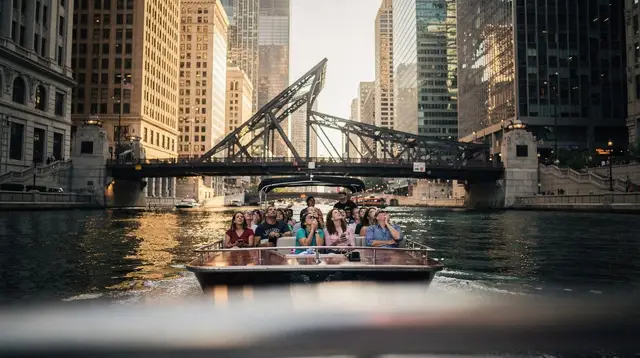
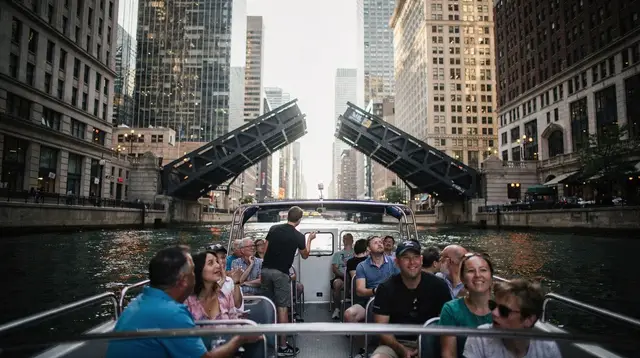
I did take the architecture boat tour that every source recommends, and for once the consensus held up — the Chicago architecture cruise along the river genuinely earned its reputation, which made me even more suspicious of the claims that did not.
The pizza argument I did not expect to have with myself
I went in assuming, because every list told me so, that deep-dish was simply “Chicago pizza.” Then I watched the people I was traveling with — and, more tellingly, the people I saw eating lunch on ordinary weekdays — reach for tavern-style, thin-crust slices far more often. Deep-dish is real, it is worth trying once, but presenting it as the everyday food of the city rather than an occasional, tourist-facing specialty is exactly the kind of flattening that happens when nobody checks the claim against actual behavior.
Skyscrapers, the Bean, and getting the basics wrong
Even the small factual claims get garbled. More than one source I read before this trip implied that the TILT platform sits atop the Willis Tower, when it is actually part of 360 Chicago at 875 North Michigan Avenue, more than two kilometers away. A walking tour built around the city’s art deco skyscrapers made this obvious fast, because you physically cannot confuse the two buildings once you have stood at the base of each one. I also did the art deco walking tour through the Loop’s skyscraper district partly to test my own assumptions, and it corrected more than one detail I had absorbed from secondhand sources without questioning them.
Milwaukee is not a Chicago neighborhood
This one is almost funny once you notice it: pieces of travel content casually fold Milwaukee into a Chicago day-trip list as though it were a far-flung suburb, when it sits in an entirely different state, Wisconsin, roughly an hour and a half away by car or by the Amtrak Hiawatha. The day trip people keep postponing deserves its own identity, not a footnote status borrowed from Chicago’s gravity.
Why any of this matters
None of this means I think the honest version of Chicago is all sunshine. Winter is cold. Some blocks genuinely warrant caution. The L does occasionally run late. I am not trying to replace one flattened story with another, rosier one. What bothers me is the gap between how confidently these claims get repeated and how little verification seems to sit behind them. A city like this changes — a neighborhood improves, a transit line gets renovated, a restaurant scene shifts — faster than a guidebook chapter gets rewritten, and the writing rarely admits that its own confidence has an expiration date.
I will also admit the obvious: everything I have written here is itself a snapshot, taken on specific days, filtered through my own itinerary and mood. In a few years, some of what I am confidently correcting here may need correcting itself. I would rather say that outright than pretend I have arrived at the final, settled version of Chicago. If a piece like the three-day itinerary for first-timers or the comparison between hop-on-hop-off buses and walking tours still gets something wrong a year from now, I hope someone calls it out the way I am calling out the last decade of recycled Chicago clichés.
Questions I kept getting asked about this trip
Is the South Side of Chicago actually dangerous for visitors?
Specific pockets have real safety concerns, like anywhere in a large city, but treating the entire South Side as a no-go zone ignores Hyde Park, the Museum of Science and Industry, and neighborhoods that see regular, uneventful foot traffic from visitors.
Is Chicago too cold to visit in winter?
Winter is genuinely cold and windy, often around 0 C by day, but calling the season a reason to skip the city dismisses the Christmas markets, indoor museum season, and lower hotel rates that make it a deliberate choice for some travelers.
Is the CTA L train unsafe or unreliable?
Delays and crowding happen, especially on lines that do not run 24 hours, but the blanket claim that the L is dangerous does not match years of ordinary, uneventful commutes on the Red and Blue lines.
Do I need a car to see Chicago properly?
No. The Loop, Riverwalk, Magnificent Mile, and much of the North Side are walkable or reachable by the L and Divvy bikes; a car mostly matters for day trips like Starved Rock or Galena.
Is deep-dish pizza actually what Chicagoans eat regularly?
Deep-dish is a tourist-facing specialty most Chicagoans eat occasionally, not a daily food; tavern-style, thin-crust pizza is what shows up more often in everyday life.
Is Milwaukee basically a Chicago suburb?
No. Milwaukee is in a different state, Wisconsin, roughly 1h30 away by car or by the Amtrak Hiawatha train, and it has its own distinct civic identity rather than functioning as an extension of Chicago.
tours.City life
Verified deep-linked GetYourGuide tours. Book through these links and we earn a small commission at no cost to you.
GetYourGuide does not provide a product photo for this activity — the image shows the meeting point, photographed by us.