Riding the L when nobody needs it
On the day I’m thinking of, it was a Tuesday, early October, and I had no real reason to be on the L at two in the afternoon. No meeting, no flight, no errand with a deadline attached. I got on anyway, at a station in the Loop, because I’d finished lunch early and the platform was closer than the sidewalk I would have otherwise taken.
The car was almost empty. Four other people, spread out along the length of it, each with enough space to not think about anyone else. That alone felt unfamiliar. Every previous ride I could remember on that same line had been a negotiation of elbows and bags, the kind of crowding that turns a train into a logistics problem you solve without noticing you’re solving it. This time there was nothing to solve. I sat by the window and, for maybe the first time on that route, actually looked out of it.
What you see from an aerial car in the middle of a weekday is not what you see from the street, and it isn’t what you see from a tour bus or a river cruise either. You’re level with the second and third floors of buildings that face the tracks — the ones nobody designed to be looked at from this angle. A gym with the blinds half-drawn. A stack of folding chairs against a brick wall. Someone’s kitchen window with a row of plants on the sill, the kind of ordinary domestic detail that a guidebook has no use for and a photograph would feel intrusive taking. You get these fragments for two or three seconds at a time, then the train clears them and gives you the next ones. Rooftop gravel and HVAC units. A mural on a wall that only the L passes close enough to read. A narrow alley you’d never walk down on purpose, seen for a moment from directly above its far end.
None of this is dramatic. That’s the part I keep coming back to. It’s not a secret vista or a postcard moment — Chicago’s skyline has plenty of those already, and they’re worth seeing from a boat on the Chicago River or from one of the city’s observation decks, where a Chicago river architecture cruise does a better job than I ever could of naming what Sullivan and Burnham and Mies van der Rohe were doing with these buildings. What the empty afternoon car gives you instead is the unremarkable texture underneath all of that — the backs of buildings rather than their fronts, the parts of the city that exist for the people who live and work in it rather than for anyone passing through.
I don’t think this is available to someone in a hurry, and I don’t think it’s available at 8:15 a.m. either, when the same window seat is occupied by someone reading a phone six inches from their face, and you’d be reading yours too if you had it. Rush hour on the L is entirely functional. It’s a machine for moving a fixed number of people to a fixed set of destinations in a fixed amount of time, and everyone on it, including me on every other day, treats it that way. There’s no failure in that. It’s what the system is for. But it does mean that most visitors to this city, and most residents, experience the L exclusively as a means to an end, and never once as a place worth being in for its own sake.
The stretch I remember most clearly ran north out of the Loop, through blocks where the aerial structure passes close enough to older brick buildings that you can see the individual courses of brick, the patched sections, the ghost signs painted on end walls decades ago and never quite fully weathered off. Somewhere past that, heading toward Lincoln Park and Old Town, the density dropped and the views opened into backyards, garden plots, a guy fixing a bike in an open garage. I had no reason to be watching any of it, and that was, I think, the whole condition for being able to watch it at all. Nobody on that car was waiting for me. I wasn’t waiting for anyone either.
I got off eventually, not because I’d arrived anywhere in particular, but because the car started filling up again as we approached a transfer point, and the spell — if that’s even the right word for something this understated — broke on its own. Once there are other people’s schedules pressing into the space, the window stops being a window and goes back to being glass with a reflection in it. I don’t think that’s a complaint. It’s just how the two versions of the same train relate to each other. One is a commute. The other, for about twenty unbothered minutes on a Tuesday, was something closer to sitting still while the city did the moving.
I’ve tried to explain this to people visiting the city for a few days, usually without much success, because it sounds like nothing when you say it out loud: I rode the train and looked out the window. Put that next to the architecture river cruise or the Riverwalk or an afternoon in Hyde Park, and it doesn’t compete for anyone’s limited time. Most visitors are right to spend their two or three days on the things that reward a short visit — the Loop’s skyscrapers, the Art Institute, a walk through Wicker Park and Bucktown or the murals in Pilsen. An empty train car doesn’t photograph well and it isn’t on anyone’s list, which might be exactly why it stays available to whoever slows down enough to notice it’s there.
If you do have an unstructured afternoon — the kind that sometimes opens up in the middle of a longer, car-free stay — riding a stretch of aerial track between 10 a.m. and 3 p.m., with nowhere specific to be, costs one Ventra fare and produces nothing you can show anyone afterward. I’d still recommend it. Later that same trip, on the platform waiting to head back south, I watched a Milwaukee-bound train pull away — the kind of trip that eventually gets you to a very different afternoon, wandering through a docent-led architecture tour of the Milwaukee Art Museum — and it struck me that the instinct is the same wherever you end up: the trip itself is rarely the empty part people assume it is. It’s usually just the part nobody left room to notice.
Even the odder corners of the region reward the same patience. Out past the city’s western edge, an evening guided ghost walk through Aurora works on a similar principle — a place most visitors drive past without a second look, until someone slows down enough to point out what’s actually there.
Common questions about riding the L off-peak
What time of day counts as off-peak on the L?
Roughly 10 a.m. to 3 p.m. on a weekday, well after the morning commute and before the afternoon one starts building. Cars thin out noticeably once the 9-to-5 crowd has cleared the platforms.
Which lines have the best views from an aerial car?
Anything running on the elevated structure through or near the Loop, plus the stretches of track that climb above street level on the North and South Sides. Underground segments obviously offer nothing to look at.
Is it safe to ride the L alone in the middle of the day?
A near-empty car in daylight is generally unremarkable and one of the more ordinary things you can do in Chicago. Normal city awareness applies, as it would on any transit system.
Do I need a special ticket to just ride around without a destination?
No. A standard Ventra fare covers the ride regardless of how many stops you pass or whether you get off at all before tapping out.
Isn’t this just describing an ordinary commute?
For most riders, yes, and that’s exactly the point. The experience described here isn’t a hidden attraction, it’s the same infrastructure looked at without the urgency that usually crowds it out.
Which sections of track feel most different from street level?
The Loop’s elevated structure and the approaches to it, where the tracks run close to upper-floor windows and rooftops rather than at ground level, change the vantage point the most.
Getting around Chicago on GetYourGuide
Verified deep-linked GetYourGuide tours. Book through these links and we earn a small commission at no cost to you.
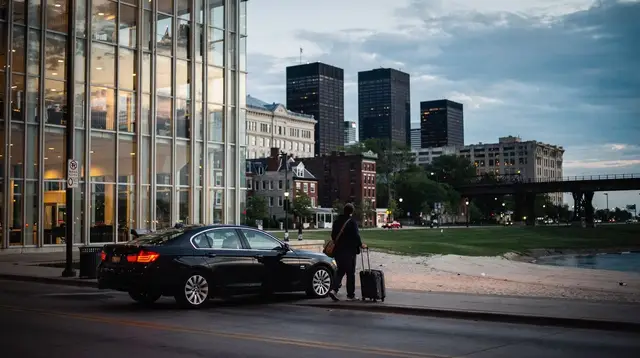
GetYourGuide does not provide a product photo for this activity — the image shows the meeting point, photographed by us.