Chicago has beaches, and nobody warned me
I did not come to Chicago for a beach day. I came for the architecture cruise, the deep-dish, the blues clubs, the whole tidy list of things a guidebook tells you to do in the Loop and Michigan Avenue before you fly home. Nobody had mentioned that on a Tuesday in July I would end up barefoot on actual sand, looking at open water that stretched to a flat horizon, with the Willis Tower standing directly behind me like it had wandered onto the wrong set.
That is the sentence I kept turning over that day: this water has no other side you can see. Lake Michigan is fresh water, not an ocean, but it does not announce that fact. There is no salt smell, no tide pulling at your ankles, but there is a horizon, there are waves that build a real chop when the wind is up, and there is a stretch of the Lakefront Trail running along it that looks, from ground level, remarkably like a coastline. I had read the fact somewhere before arriving — freshwater lake, fifth-largest in the world by surface area — and filed it away as trivia. Standing in it is a different kind of knowledge.
A city I thought I knew from one season
Every image I had carried into Chicago came from winter. Wind off the lake, gray light, people leaning into the cold on their way to the L. That is not an unfair picture — Chicago earns the Windy City reputation honestly, and the season everyone warns you about is a real one, not exaggerated for effect. But it is only one half of a city that apparently runs on two completely different registers, six months apart, and almost nobody had told me about the other half.
The day I’m describing started in the Loop, the way most Chicago days do for a first-time visitor, wandering between the skyscrapers near Willis Tower with a coffee and no particular plan. Somebody I’d met the night before mentioned, almost as an aside, that she was headed to the beach after work. I assumed I’d misheard her, or that she meant something adjacent to a beach — a waterfront bar, a rooftop with a view. She meant an actual beach, with a lifeguard chair and a snack stand, a twenty-minute ride from downtown.
The walk that changes what you think this city is
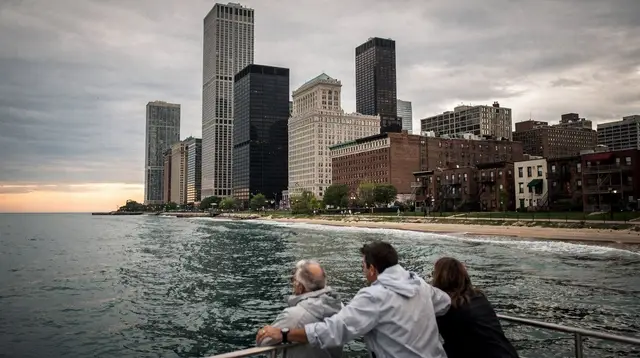
What struck me first was not the sand itself but the sightline. You come off a side street, past a row of apartment buildings, and the ground just opens into water and light, and if you turn around, the skyline is sitting right there behind you, close enough that the whole scene looks staged. I have stood on plenty of ocean beaches with a city in the distance — that’s a familiar postcard. I had never stood on a beach where the density of a major American downtown was practically at my back, no buffer zone, no long drive to get there.
People were doing what people do at any beach in late summer: reading, wading, half-watching kids near the shoreline, eating something out of a cooler. A couple of teenagers were paddling out past the swim buoys on inflatable boards. None of it looked remarkable to anyone else there. That’s the part I keep coming back to — for the people who live here, this is just Tuesday in July. For me, it broke a mental category I didn’t know I was carrying, the one that files “Chicago” under skyscrapers and cold and keeps “beach town” in a separate drawer entirely.
Why the double identity stays hidden
I think the reason this side of the city stays underplayed is structural, not accidental. The things that define Chicago’s reputation abroad — the architecture river cruise, the Art Institute, the deep-dish debate, the blues clubs on the South Side — are all things you can market and photograph year-round, or at least across three seasons. A beach day is a four-month story at best, tucked between a slow spring and an early fall, and it competes for attention with a much louder, more photogenic set of landmarks that don’t care what the calendar says.
There’s also the matter of expectation management. Nobody wants to be the visitor who booked a July trip expecting Miami and found a cool, wind-affected freshwater lake that only really warms up by August. So the guidebooks hedge, and the hedging quietly erases the experience rather than framing it honestly. What I’d tell someone now is simpler than any hedge: it is not an ocean, the water stays cooler than you’d expect even in peak summer, and it is still one of the more disorienting, worthwhile afternoons the city has to offer, precisely because it contradicts everything you thought you knew about the place.
What I did with the rest of that evening
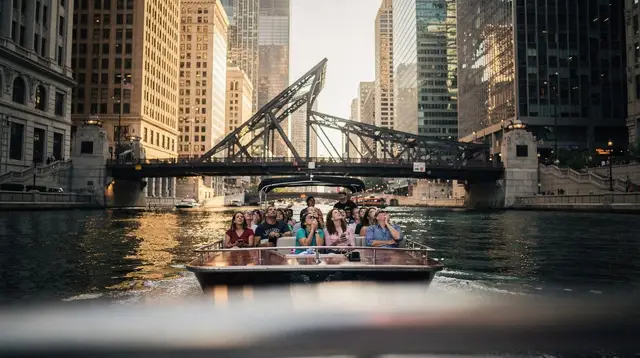
Later that week I went out on the water itself rather than just next to it, on a small sailing outing that leaves from the harbor near downtown — a private sailing charter on Lake Michigan that puts the skyline on the horizon instead of at your back, which turns out to be the better angle for understanding how the city actually sits against the water. If sailing isn’t your speed, a shoreline cruise along the lakefront covers similar ground at a slower pace, with more time to actually look rather than manage a boat.
Neither replaced that first walk onto the sand, though. That one was unplanned, unphotographed for the first ten minutes because I was too busy recalibrating, and it did more to change how I think about this city than any single stop on the architecture-focused itinerary I’d mapped out before arriving. If you’re building a first Chicago trip around the towers and the river, it’s worth carving out one afternoon for the lakefront on its own terms — not as a checklist item, but as the other half of the city that the postcards don’t usually show you.
I still think about the wind, honestly. It shows up in both seasons, just differently — biting off the frozen lake in January, and cutting the summer heat into something bearable in July. Maybe that’s the throughline nobody points out clearly enough: this is fundamentally a lake city, in winter and in summer both, and the Riverwalk downtown is only the most photographed of its relationships with the water, not the only one. The beach is the version that never made it into my mental picture of Chicago, and it’s the one I’d tell a first-time visitor to plan for the most deliberately, because nobody else is going to mention it to them either.
For anyone comparing notes on how the two seasons actually feel on the ground, the winter side of this contrast and ten years of change along the water downtown are worth reading alongside this one — and for planning purposes, the lakefront activity listings and the lake cruise options are a reasonable next stop, along with a look at biking the full length of the trail or paddleboarding out from shore if a beach towel alone doesn’t feel like enough. If you’d rather see the whole thing from a boat instead of the sand, Winter activities in Chicago: what actually works in the cold makes a useful counterpoint for when you’re weighing which season to actually book.
Lake Michigan beaches, in short
Is Lake Michigan salt water or fresh water?
Fresh water — one of the five Great Lakes, with no tide and no salt, though the horizon and wave action can fool you into thinking otherwise.
Why don’t more people associate Chicago with beaches?
The city’s reputation is built on architecture, food and winter weather, so the several months a year when the lakefront runs like a genuine beach town rarely make it into the standard narrative.
When is the lake actually swimmable in Chicago?
Roughly late May through early September, when city beaches are open and staffed. Outside that window the water is still there, but cold and unsupervised.
Can you see the Chicago skyline from the beach?
From several beaches close to downtown, yes — the towers of the Loop and the Magnificent Mile sit right behind the sand, which is the specific contrast that surprises most first-time visitors.
Is the lake water clean enough to swim in?
Generally yes during the monitored swim season, though like any urban waterfront it can carry advisories after heavy rain. Check current conditions for the specific beach before heading out.
Do winter and summer Chicago feel like different cities?
That contrast is close to the whole point of this piece — a city known for wind off a frozen lake runs a real beach season a few months later, and the gap between those two images is wider than most guidebooks admit.
Seasonal tours and activities on GetYourGuide
Verified deep-linked GetYourGuide tours. Book through these links and we earn a small commission at no cost to you.
GetYourGuide does not provide a product photo for this activity — the image shows the meeting point, photographed by us.